Regeneration and renewal
Charcoal and Agitato
ORBIT Program A
Saturday 31st October, 2026
Sylvia Staehli Theatre
Dancehouse, Melbourne
In Orbit, my response to Charcoal and Agitato, drawn up especially for Fjord Review.
To travel round, like the earth in its recurrent, elliptical revolution around the sun, is no mean feat. Touring is a complicated, lengthy and costly affair. As such ORBIT, a new touring program devised to do just that, plans to “not only enable artists to tour, but bring incredible independent dance to audiences across the country”[i]. Three sister organisations, Dancehouse (Victoria), Australian Dance Theatre (South Australia), and Sydney Dance Company (New South Wales), supported by Creative Australia, afford and invite audiences to “revel in this ORBIT” made possible by “a constellation of dance artists” with four works, over two parts, which “celebrate Australia’s local independent choreographers”[ii].
Program A finds me hopping on the circuit with proud Githabul, Migunberri, Yumbeh woman, Keia McGrady’s regeneration after cultural burning, “Charcoal”, and the legendary Jo Lloyd’s rewriting of tragedy, Agitato, back-to-back at Sylvia Staehli Theatre, Dancehouse, Melbourne. Charcoal premiered as part of the Junction Arts Festival, at the Annexe Theatre, Lutruwita / Tasmania, in 2024, and Agitato premiered last year at Dancehouse, and having seen neither work before, I am here for the journey in all its time expansion and brilliance. I am ready to look into the marks we leave behind.
As I enter the darkened theatre, at the foot of the stage, a large, folded, raw canvas basks in a warm glow. Distinctive, tell-tale charcoal smudges intimate what might unfurl, and render the stage “a living, breathing presence”, just as Country is a living, breathing presence. For Charcoal is not “just a performance. This is offering. This is remembering”[iii]. As McGrady, joined by Amelia Jean O’Leary (Gamilaroi and Wadawurrung Yinarr), purposefully open the canvas, to the left and right, as if it were a book or an unstretched painting, the growing of the space is captivating. What was large is larger still, a broad expanse, a revelation. Across the surface a series of gestural marks in charcoal dance. A variety of sweeping curves and heavier, angular lines, they tell of place, memory, and learning. To the right, a lighter, fluid shape, river-like in its unfixed margins, is in contrast to the directional lines radiating from a central point, on the left.
From the centre point, two smudged circles on either side anchor the picture plane and indicate where McGrady and O’Leary have previously sat, two figures of and reading place. And as they do so, with lighting by Jason James, their silhouettes cast onto the canvas add soft strokes to the living drawing, in the perpetual shift of place meets map meets dance meets drawing. “Through the body and onto canvas, [they are tracing] a dialogue between spirit and land — a mapping of place both seen and felt”[iv]. When McGrady and O’Leary stand and begin to rotate in their respective circles, a pleasing crackling noise builds an audible layer. Underfoot, charcoal snaps into shards and shades the soles of their feet. They have not so much become the drawing, rather they are a rendering of how nutrients travel through a tree, wisdom, through gesture, and how knowledge is passed, embedded, and understood. Later drawing with the sticks of charcoal, in a quiet meditation, the presented visual, laced with meaning, is so rich that my earlier sensation of having wished to see the drawing from the beginning slips away[v]. As O’Leary traces the straight lines, back and forth with an extended foot, the lines become darker yet less pronounced as the edges are smudged, and McGrady curls her form into the sinuous shape of a river. The physical and the felt, side by side, residue of the charcoal serves as a metaphor for the aftermath of cultural burning and the regeneration and renewal which follows.
Recurring movement phrases, from arm swinging to stomping, in unison and isolation, together and apart, flow through into Lloyd’s Agitato on diagonal pathways I’d no way of anticipating. Returning to the very same theatre, after a pause in the middle, an undercurrent of renewal.
A piano sounds and I hear not just the note, but a sense of the person who struck the key. That is, I hear the person playing the instrument and not merely the instrument. This is true even though I am listening to and experiencing a recording of the piece. The piece is Allegro molto agitato in D Minor by Fanny Mendelssohn[vi], and on its journey from 1823 it has met with fellow composer Duane Morrison and this interpretation offers a way into the original composition and, by turn, into Lloyd’s work of the same, if truncated, name. Lloyd’s Agitato emphasises the hand striking the keys, the music being the core of the work. As Lloyd describes, “Duane and I had an interest in fictionalising what would Fanny Mendelssohn do if she created an album now”. From here, spun “fictional ideas of ‘what if’” and like the charcoal shards of Charcoal or the breaking of a mirror, Agitato turns inside out “this idea of shattering everything into pieces”[vii]. Two works looking at pieces and assembling them anew in order to gain a deeper understanding. Two works that breathe with knowledge passed down.
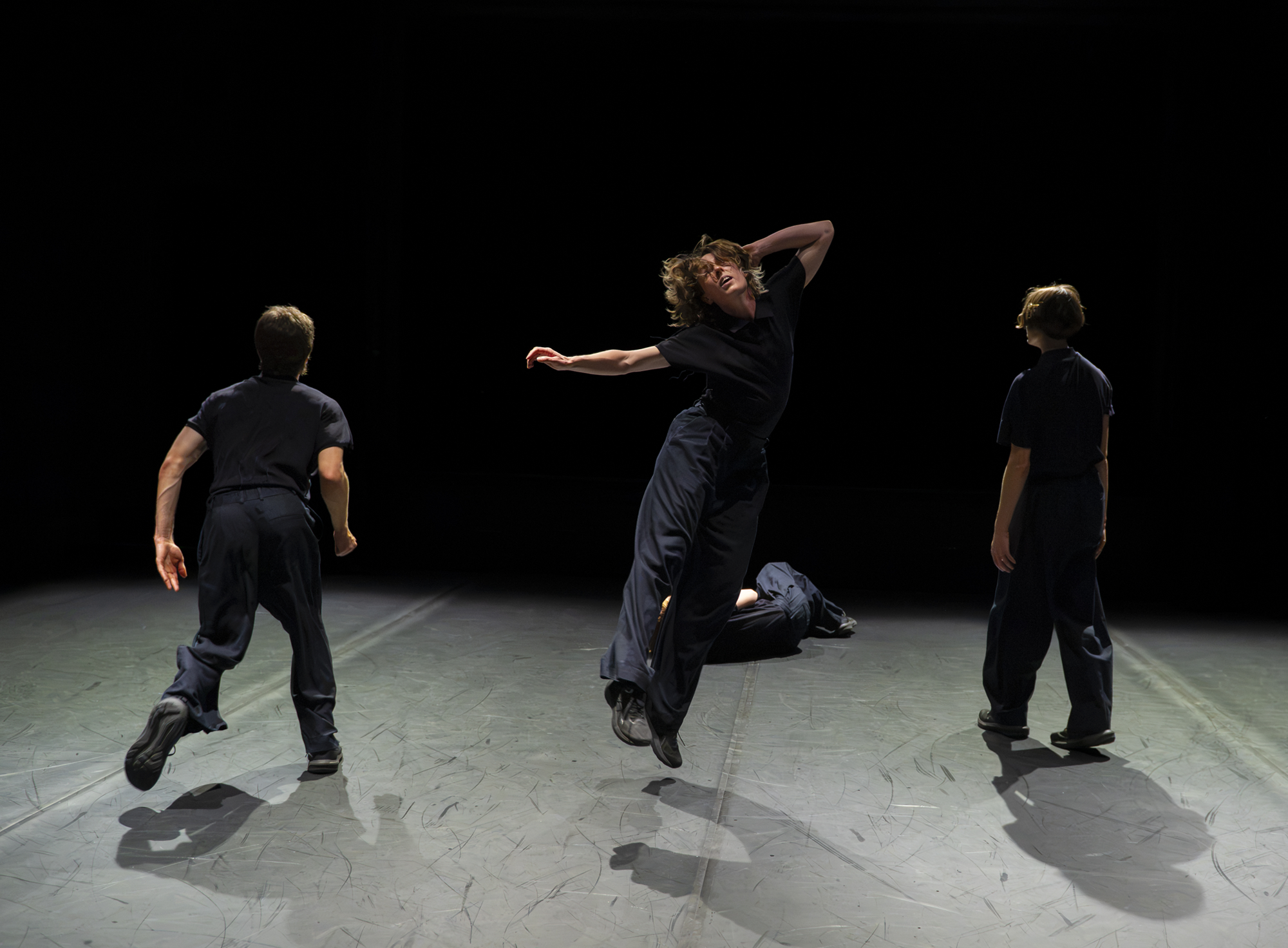
Fanny’s imagined concept album, with its spirited, individualistic streak, is suitably devoid of the superfluous. Channelled by Lloyd and Thomas Woodman, this time the quartet is rounded out by Rebecca Jensen and Louie Wisby embodying sound, feeling and time. For though some movements could be read in response to Fanny being informed by her father that while music was a profession suitable for Felix, “for you it will always remain but an ornament”[iix], Agitato is a state and a connection. On the angle, the dancers remove their tops and run, bare-chested, jubilant and free. Hands raised overhead, onward they plough, in creation of a hallmark, and in search of a shared understanding. Release, glorious release, is a recurring physical motif. To Lloyd, the dancers are “working with both the music being played” and what it feels like in their imagination. They are “the idea of playing the piano and being the piano… [they] are trying to embody musical creation within [their] own bodies.”[ix]
Wisby dips her chin down and knocks her head between Jensen’s shoulder blades. Jensen folds to the floor. When they repeat this sequence a second time, the same movement conveys a different energy. Elsewhere, in an asymmetrical arrangement, Jensen whispers into Lloyd’s ear, and Lloyd, concealing her response, gives nothing away. Elsewhere, Lloyd looks down the centreline of the stage before charging, in one of the few moments when the audience is acknowledged. Or she spins, kicking her right leg out high to the side before bringing her right arm swiftly down to meet it, and then whipping her entire form around, clockwise. Her hair draws lines against the dark ground. The flow of energy apparent as she propels herself through space.
Movements grow from small to large, fast to slow, from ordered to disordered, extended to compressed, ensuring what might have been the same always strikes differently. To the score, affix the sound of sneakers squeaking as they intentionally strike and swish at the floor. As the piano increases in intensity, testing the stamina of the dancers, the sound of the friction of rubber soles as they make contact with the floor is, to me, akin to fingernails down a blackboard. Agitato repeatedly changes direction, control, and in the stop-start, all four pause on the balls of their feet, mid lunge. In the pause, catch your breath, this is, in Fanny’s own words, a “virtuosic whirlwind”[x].
[i] ‘What is ORBIT?’, Australian Dance Theatre website, https://adt.org.au/for-artists/orbit, accessed 31st October, 2026.
[ii] Joshua Wright, CEO / Artistic Director of Dancehouse, on behalf of ORBIT partners Australian Dance Theatre and Sydney Dance Company, ORBIT Program published by Sydney Dance Company, https://issuu.com/sydneydancecompany/docs/orbit_program, accessed 31st October, 2026.
[iii] Keia McGrady’s Charcoal, Performing Lines, https://performinglines.org.au/projects/charcoal/, accessed 1st November, 2026.
[iv] Keia McGrady’s Charcoal, Performing Lines, https://performinglines.org.au/projects/charcoal/, 2026.
[v] I attended the third performance of Charcoal at Dancehouse, and am presuming that the drawing changes states over the show’s run.
[vi] Fanny Mendelssohn-Hensel “was a significant composer, but her career was restrained by early 19th-century attitudes toward women. [Her younger brother] Felix Mendelssohn wrote that publishing her music “would only disturb her in” her “primary duties” of managing her home. Several songs were published under Felix’s name, Italien (Grillparzer), becoming a favourite of Queen Victoria.” Naxos website, https://www.naxos.com/Bio/Person/Fanny_MendelHensel/27352, accessed 1st November, 2026.
[vii] Jo Lloyd in interview for Dancehouse, Dancehouse Instagram account, https://www.instagram.com/p/DfGWVVByiUC/, accessed 1st November, 2026.
[iix] Sheila Heyman, ‘“Music for you must only be an ornament”: how Fanny Mendelssohn’s voice was stifled, then saved’, The Guardian, https://www.theguardian.com/music/2023/oct/25/fanny-the-other-mendelssohn-by-sheila-hayman-film-music-must-only-be-an-ornament, 25th October, 2023, accessed 1st November, 2026.
[ix] Jo Lloyd in interview with Leila Lois, ‘The Art of Exploration’, Fjord Review, https://fjordreview.com/blogs/all/the-art-of-exploration, accessed 31st October, 2026.
[x] “Agitato” synopsis, Sydney Dance Company website, https://my.sydneydancecompany.com/2462, accessed 31st October, 2026.
Charcoal — Regeneration after burning
Lead Artist & Performer: Keia McGrady (Githabul Migunberri Gomeroi)
Performer: Amelia Jean O’Leary (Gamilaroi and Wadawurrung Yinarr)
Sound Composer: Joshua Santospirito & Waveney Yasso (Yuwi Burra & South Sea Island)
Sound Engineer: Joshua Santospirito
Lighting Designer & AV: Jason James
Original Costume Designer: Noah Johnson
Agitato — Rewriting tragedy
Choreographer: Jo Lloyd
Dancers: Rebecca Jensen, Jo Lloyd, Louie Wisby, Thomas Woodman
Composer: Duane Morrison
Costume Designer: Andrew Treloar
Lighting Designer: Shiv Geaney
Dramaturg: Anny Mokotow
Dancers in Original Production: Harrison Ritchie-Jones, Lee Serle
Image credit: Rebecca Jensen, Jo Lloyd, Louie Wisby, Thomas Woodman in Llyod's Agitato, photographed by Gregory Lorenzutti

I have been collaborating with Louise Jennison since 1999, making artists’ books, collages, large-scale installations, prints, drawings, zines, and various tales. Besotted still, it appears, with paper for its adaptable, concealable, revealing nature, we use an armoury of play, the poetic and familiar too, with the intention of luring you into our A(rtists’ books) to Z(ines).
As artists and wildlife carers, our practice frequently concerns the natural world, addressing themes of conservation and biodiversity. Our home-based studio is also home to our wildlife shelter, Tiny but Wild.
I collage with words about dance for Fjord Review.