At the intersection
Inaugural Australian Dance Biennial during RISING festival
Glow
Gideon Obarzanek
Thursday 28th May, 2026
Chunky Move Studios, Southbank
Love Lock and Forever & Ever
Sydney Dance Company by Melanie Lane and Antony Hamilton
Thursday 4th June, 2026
Playhouse, Arts Centre, Melbourne
Glow
Concept & Choreography: Gideon Obarzanek
Media Artist: Frieder Weiss
Music & Sound Design: Luke Smiles/Motion Laboratories
Additional Music: Ben Frost
Costume Design: Paula Levis
Rehearsal Director: Sara Black
Performers: Sara Black, Melissa Pham & Layla Meadows
Technical Director & Operator: Nick Roux
Production Manager: Benjamin Beare
Stage & Production Manager: Holly Anderson
Love Lock
Choreographer: Melanie Lane
Composer: Clark
Lighting and Set Designer: Damien Cooper
Costume Designer: Akira Isogawa
Forever & Ever
Choreographer: Antony Hamilton
Composer: Julian Hamilton
Costume Designer: Paula Levis
Lighting Designer: Ben Cisterne
Crossing the Line, my response to works presented at the Inaugural Australian Dance Biennial during RISING festival, drawn up especially for Fjord Review.
At the vertical and horizontal intersection of two white lines on a darkened stage, performer Layla Meadows and her corresponding organic outline appears. For this restaging of Glow, a work choreographed by Gideon Obarzanek for the Melbourne Festival in 2006, it is Meadows’s time to be scanned and surveyed in this duet between a dancer and a machine. For the 20th anniversary season of Glow, presented as part of the inaugural Australian Dance Biennial during the 2026 RISING festival, she is being joined by original cast member Sara Black[i] and Melissa Pham. Rolled forward, making a snail shell of her back and tail, Meadows scuttles, propelled by her feet, her head and shoulders anchored to the ground. She interrupts the vertical and horizontal lines with her presence, ensuring they cannot meet. Rather, the straight lines have to go around her, they have to bend. The snail, or is she perhaps more of a hermit crab beneath a shell, is disrupting the meeting point.
Onwards she hastens on the axis. And with this adherence, the sense that she is not in control, that the path is in fact predetermined, dawns. This world, it is one that favours straight lines and known outcomes. The earlier freedom, a blip. Perhaps. In costuming by Paula Levis, with sleeves for protection, crossover neckline for flexibility and glove-like coverage[ii], Meadows maps the illuminated screen of the stage floor, and the machine above scans her every move. There is no visual escape for the hybrid snail meets hermit crab. Flanked by raked seating on all four sides of the stage, the scrutiny is as intense at the sound and lighting (by Luke Smiles/Motion Laboratories).
Berlin-based interactive software developer and media artist Frieder Weiss[iii] is in Melbourne to help with the remounting, and though the technology has changed, it has lost none of its power. Meeting points between the body and machine, softer casings and harder ones, and the provocation of just who is responding to who, the conversation is as relevant now as it was then. As spirograph-like forms emanate, in response to Meadows’s extending a limb into the white plain before my eyes, though the balance of power swings, the use of technology throughout Glow never overwhelms the dancer. In geometric-patterned, optical-illusionists’ awe, the human, once more, is directing the scene. A moving arm is followed by a string of playful lines. The machine is responding to human actions. Round she goes, a web drawn, and depth of field suggested. These radiant linear projections are reminiscent of tree rings growing around Meadows. Upon a stage floor painfully bright, the lines close in and make a coffin shape. It is tenuous, it is changeable, this encounter.
Primarily floor-based, Meadows’s moves through sequences that appear to reference an exorcism and elsewhere impart a soft glow to the edges of her form, making her aura visible. In a universe where change is swift and contrast high, she makes vocal utterances, and allows us to hear the labour of her breathing, which heightens the voyeuristic nature of watching human vs machine: when did the conversation slip into a competition? At one point, standing upright in the arena, Meadows’s leaves a series of inkblots on the stage. The inkblots initially move as if shadows previously cast are now independently animated. They quickly mutate into an oily and conscious globular form. They have a sentience to them, but above all, they carry a sense of menace. They stalk her on the stage in active pursuit. No matter where she goes, within the confines of the grid, she is found, and once found, she is a host to be consumed by darkness. Though Meadows becomes a vessel for the angry, sorrowful matter, this is not where things end. As a white light bathes the stage before shrinking to a pinprick, the last note is more hopeful. If humanity can ‘call the shots’ on technology and how it is used, perhaps a different outcome, a different future, is possible. Quick. Let’s pause it here.
Notions of a different future being possible flow into Melanie Lane’s Love Lock, presented by Sydney Dance Company at the Playhouse, Arts Centre Melbourne, alongside the return of Antony Hamilton’s Forever & Ever, with its exquisite quiet solo at the beginning of the beginning, as the audience takes their seats. Love Lock, which debuted in 2024, cracks open a view to a new world being forged, and it bears wings, moss, and the promise, as Etta James’s crooned, of “life… like a song”.
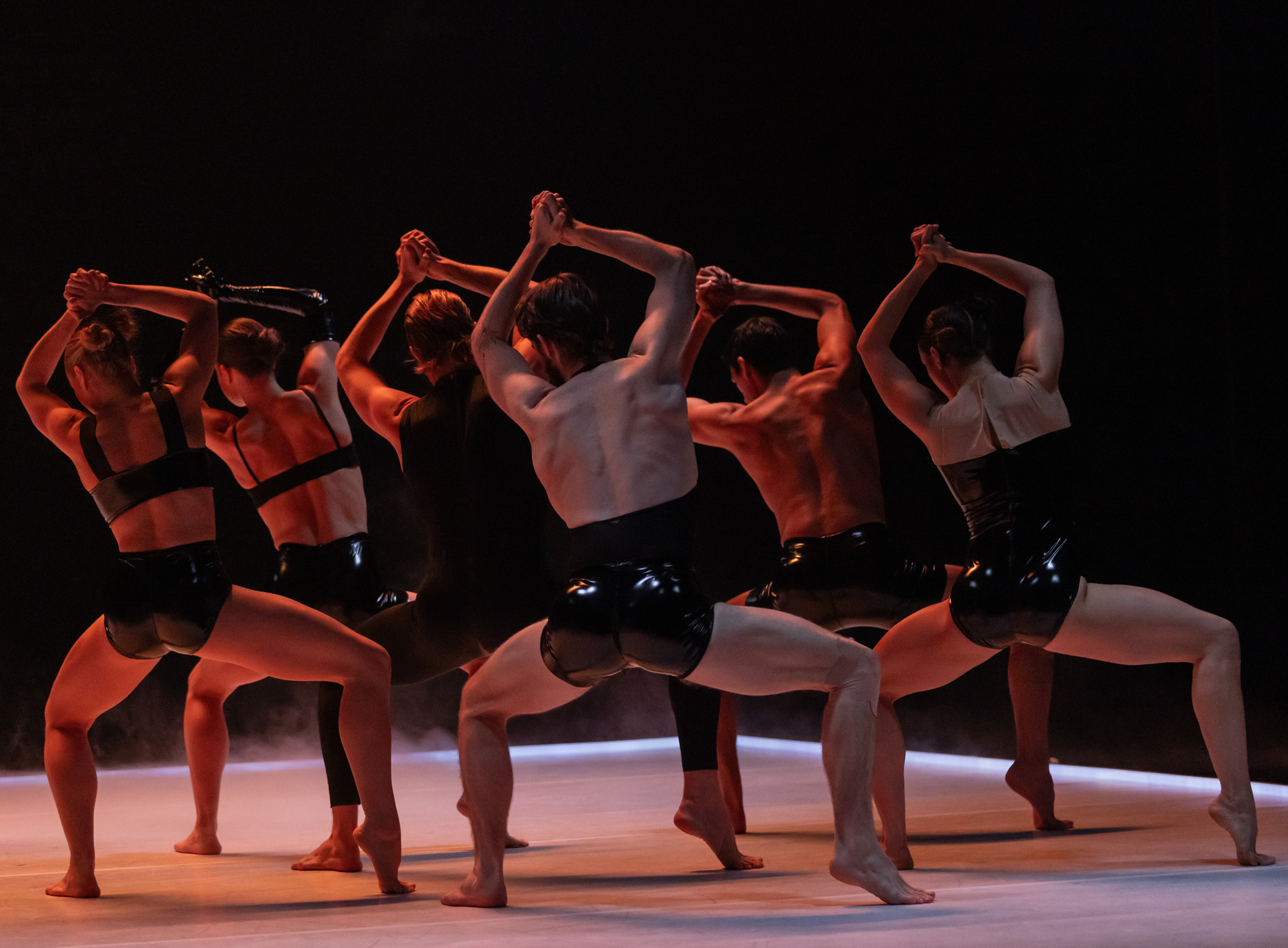
In Lane’s Love Lock, it is as if the one lone dancer of Glow has multiplied. The stage is gridded, this time, by a low bank of lights, so low each lamp reads similar to the thick trunk of a tree from which the rigging looks like the continuation of the tree. A forest of squat trees visible through an early morning mist at the dawn chorus summons the unchanging eternal and the folkloric simultaneously. The stage of Glow has regenerated, and bird calls fill the air. As each dancer emerges from the periphery, they remain in their own world. Their “lonely days” not yet behind them. They mimic each other, but, as with Glow, this feels characteristic of a solo. There is preening and posturing. Timmy Blankenship stretches and fans his arms, balancing high on the balls of his feet. Elsewhere Finn Armstrong and Sophie Jones tiptoe across the forest floor, emulating Blankenship’s movements. They stalk the stage, they rotate their wrists as if with the next rotation wing feathers will sprout. Indeed, upon Armstrong’s crown, wings like Mercury appear above the ears.
Even when dancing in pairs or larger groupings, the focus feels inward. And yet the dancers also appear keenly aware of how they might look or be perceived, by those around them on the stage, and by the audience as well. There is a heightened awareness of ‘be seen’ and ‘be seen, brilliantly’, for though practising their mimicry in a bid to woo comes to mind, this is the time-old art of peacocking. Be aware of all angles and make all angles appealing. Having shed their fuzzy insulation down, in costumes by Akira Isogawa, the dancers grow into mysterious, ostentatious birds. More and more elaborate costumes are donned and the colour palette becomes radiant and textural. The dancers’ utter songs, in mumbled calls. “How deep is your love” takes on a staccato form, with each word hanging on its own. Bathed in the brightest of lights, the dancers kneel and flutter their palms as they utter: How. Deep. Is. Your. Love. How. Deep.
Elsewhere, it is not possible to hear what is being said, much like a forest or a club floor. Pieces are heard, misheard, threaded together. Like a Lyrebird’s call mimicking other birds in their vicinity, from Kookaburras to Bellbirds, lyrics are picked up from here and there in kaleidoscopic rotation. They ping around the room, and make a new audio scape, one befitting of a new world. Clark’s deconstructed love song composition together with the dancers’ incantations weaves an audible aura, conjuring how things feel. “In an accelerated era where we navigate love both in person and in the digital space, the experience of love can be both intense and slippery… Love Lock’s collective dreaming … insists on a dance that celebrates our hearts.”[iv] At last.
[i] Sara Black received a Helpmann Award for Best Female Dancer for her performance in Glow in 2006, and has been the rehearsal director for this remounting. Glow received a Helpmann Award for Best Dance Work and a Green Room Award for Design, and has toured festivals and venues worldwide.
[ii] Award-winning costume designer Paula Levis revisits the original costume she created for the 2006 season of Glow now preserved in the Australian Performing Arts Collection at Arts Centre Melbourne, Chunky Move Instagram account, https://www.instagram.com/p/DYy4CtPAWvl/, accessed 28th May, 2026.
[iii] “Glow works with a system consisting of an infrared video camera and a PC with the Kalypso software running…. The software also allows flexible structuring of the performance time, images are morphed and blended into each other.” Frieder Weiss website, https://frieder-weiss.de/works/all/Glow.php, accessed 28th May, 2026.
[iv] Melanie Lane, ‘A Note from the Choreographer’, Sydney Dance Company’s Love Lock and Forever & Ever RISING festival 2026 program, page 9, https://issuu.com/sydneydancecompany/docs/rising_program_v2_feedback, accessed 4th June, 2026.
Subscribe to and support Fjord Review.
Fjord Review is a world-class review of ballet and dance. Edited by Penelope Ford, Fjord publishes original dance criticism, interviews, features, essays, photography, and hosts the podcast, Talking Pointes, a bronze medalist for the Best Arts & Culture podcast by the Australian Podcast awards in 2022. Our contributors, based in five continents, are dance scholars, critics, artists, and emerging voices united by a passion and gift for illuminating dance. In 2018, Fjord was nominated for a Canadian National Magazine Award for excellence in digital publishing, and since 2019 we have published a biannual print magazine.
Fjord Review reaches over a hundred thousand readers each year, and delivers a weekly dance digest newsletter to thousands of dance enthusiasts each week. Whether you are a self-confessed balletomane or new to dance, we hope you find a companion in Fjord Review.
Image credit: Sydney Dance Company in Melanie Lane’s Love Lock, by Pedro Greig
