“These ancient trees ground us”
Three stories of Country. One message of hope.
Sheltering
Bangarra Dance Theatre
Friday 19th June, 2026
Playhouse, Arts Centre Melbourne
Wurundjeri Country
SHEOAK
Choreographers: Frances Rings, The Dancers of Bangarra Dance Theatre
Composer: David Page (dec.)
Set Designer: Jacob Nash
Costume Designer: Jennifer Irwin
Lighting Designer: Karen Norris
KEEPING GROUNDED
Choreographers: Glory Tuohy-Daniell, The Dancers of Bangarra Dance Theatre
Composer: Brendon Boney
Set Designer: Shana O'Brien
Costume Designer: Clair Parker
Lighting Designer: Karen Norris
Rigging Consultant: Katie McDonagh
Creative Mentors: Jacob Nash, Matt Cornell
BROWN BOYS
Choreographer: Daniel Mateo
Directors: Cass Mortimer Eipper, Daniel Mateo
Composer: Leon Rodgers
Set and Costume Design: Elizabeth Gadsby
Director of Photography: Liam Brennan
Producer: Michaela Le
Sheltering affords a safe place in which to pause and turn over, like a leaf in your palm, ideas and practices about how to navigate in a shifting world. In Bangarra Dance Theatre’s triple bill, which opened recently at the Playhouse at Arts Centre Melbourne, shelter is found in the form of Glory Tuohy-Daniell’s 2026 reimaging of Keeping Grounded, first created in 2023’s Dance Clan; Brown Boys, a film choreographed and directed by Daniel Mateo and Cass Mortimer Eipper; and Frances Rings’s Sheoak, which was originally developed as part of the Lore double-bill program in 2015, under Stephen Page’s artistic direction. Understanding the extent of disruption, which (in my Western thinking) is often described as a baseline reading required to inform a pathway forward: you cannot understand what has been lost, if you don’t know what came before. It is only by listening to those around you that you can tell what species were plentiful, what trees grew, and what rivers flowed. It is through intergenerational conversations that we learn what needs to be protected, cared for, and brought back, in the sped-up age of want and take. It is through connection, awareness and action that the destruction caused by Western hands and human greed can be repaired.
People, Land, and Spirit, my response to Bangarra Dance Theatre’s Sheltering, drawn up especially for Fjord Review.
Sheltering, Bangarra Dance Theatre’s new triple bill having opened in Canberra, on Ngunnawal Country, is on its national tour, and much like the definition to ‘take shelter’, the choreographers and the dancers ask the audience to actively look at from whom and from what a community or an individual might need to take shelter from. To me, this questioning is what lies at the core of Sheltering: from what, from whom, and further to that, what will you do with this awareness? Beneath the mantle of three stories of Country, one message of hope, Bangarra Dance Theatre inspires activation in all her forms.
Told in three sections Place, Body, and Spirit, Frances Rings’s Sheoak is a lesson still to be learned, as relevant now as it was when it debuted. Like the endangered Sheoak tree, endemic to Australia, and much of our flora and fauna, “Indigenous languages, customs, and lore [are also under] threat”[i]. And so, this work is both about the Sheoak tree, whose green branchlets of scales (leaves) resemble the feathers of the Cassowary (hence belonging to the family Casaurinaceae), and the role the grandmother tree plays. “The Sheoak, like the grandmother, has a role in family and community life that is about protection, the wisdom of elders, life’s journey and the spirit of survival. Children were often left under the protective bough of the Sheaok while parents gathered food. Since ancient times, the Sheoak tree has provided Aboriginal people with wood for weapons, tools and even canoes and the branches were used for windbreaks and shelters.”[ii] Choreographed by Mirning woman, Rings, with music by Munaldjali and Nunukul man and renowned composer David “Dubbo” Page, whose legacy resides “in the heartbeat of Bangarra’s storytelling”[iii], the Sheoak tree is symbolic; the roots of the Sheoak are the past; the trunk, the present; and the branches, the future.
In Place the Sheoak tree on the stage before me bears hope, hope in the sense of rising again. The Scar Tree cast mourn the loss of the fallen trees, and in doing so, rise again, and “adapt to a new way of life”[iv]. In beautiful, textured costumes by Jennifer Irwin, which bear stylised elements of the tree herself, the Scar Tree cast form a loose circle, and several dancers slowly lift one another from the ground. With feet slightly flexed as they are raised, torsos facing upwards, they gently settle like a new shoot. Those held aloft sway as if, like the branches themselves, their limbs are being moved by the elements, and the effect is mesmerising. Whether in full ensemble moments or solos, like that of the Sheoak Spirit, the sense of renewal is palpable.
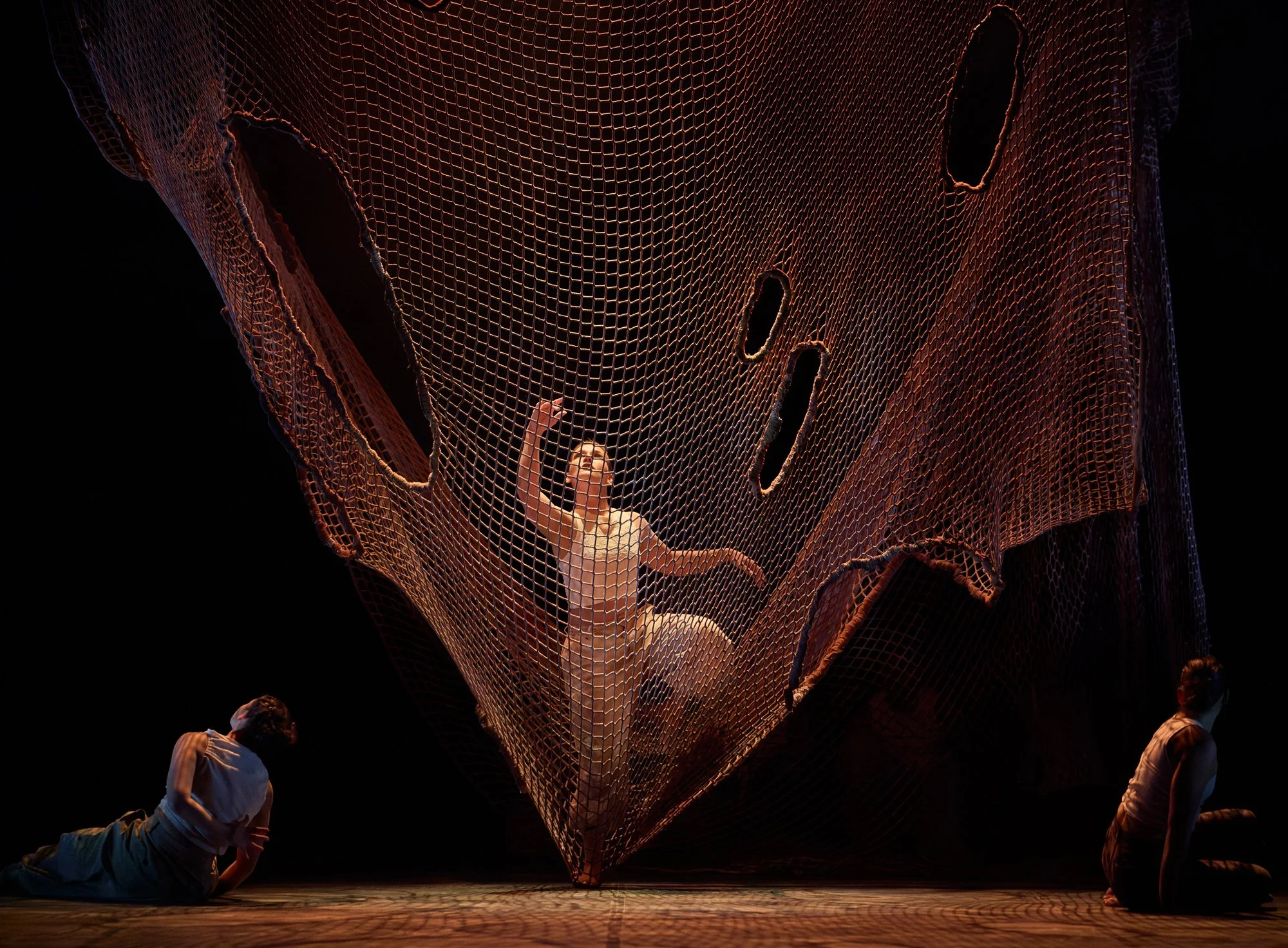
Earlier, unfurling in several sections from Migi (ground) to Ngulibi (water), Indjalandji-Dhidhanu and Alyewarre woman Glory Tuohy-Daniell’s Keeping Grounded offered forth similar moments of beauty and truth. With a set design by Shana O'Brien, the tie to earth took form in the presence of a giant net, which first appeared draped across the dancers on the stage floor, like a hug, a skin, a piece of them. “You arrive as one person, but you are not alone there;”[v] your ancestors, memory, and presence will ground you. The net, once lifted and hung from high overhead bore several holes with reinforced seams, from Guliyapa (cheeky), and the pursuit of money and greed over kin. Holes through which the dancers climbed or fell through as they sought reconnection to land and place. The dancers scaled the net with ease, in symbolic, conscious choice of letting go, soft like water (“Ngulibi”).
At the intersection, a six-minute film choreographed and directed by Daniel Mateo and Cass Mortimer Eipper, and featuring Mateo’s spoken word and body poem, Brown Boys, illuminated the theatre in a powerful, heartfelt act of reclamation. First presented in 2024’s Dance Clan, the film began with Mateo in a Tongan shelter, called a Fale, which slowly came apart, and drew upon lived experience to address issues of identity on a personal to universal level. The closing image of Mateo, a descendant of the Gomeroi people of northeast NSW as well as the Tongan people from the Pacifika region, waist-deep in a mound of dark earth was as striking as it was loaded and necessary.
To the trees, and their custodians, beneath their canopy, let the final note sound: “These ancient trees ground us and keep us connected to something that transcends our modern life and binds us to our birthright.”[vi]
[i] Frances Rings on Sheoak, Bangarra Dance Theatre: Knowledge Ground, https://bangarra-knowledgeground.com.au/productions/lore/frances-rings-on-sheoak-lore, accessed 20th June 20, 2026.
[ii] Lore: Dance Stories of Land and Sea, Bangarra Dance Theatre: Teachers’ Resource, 2015 https://d3ihitrw16qgsp.cloudfront.net/uploads/resources/LORE-Study-Guide.pdf, accessed 20th June, 2026
[iii] ‘Roy Davidson “Dubbo” Page (1961–2016)’, Bangarra Dance Theatre Sheltering printed program, 2026, pp. 14–15.
[iv] Sheoak synopsis, Bangarra Dance Theatre Sheltering program, p.12.
[v] Keeping Grounded synopsis, Bangarra Dance Theatre Sheltering program, p.11.
[vi] Sheltering, Bangarra Dance Theatre: Study Guide, 2026, p. 12, https://www.bangarra.com.au/media/k4rjgzdd/bdt-shelteringstudyguidea4web.pdf, accessed 20th June, 2026.
Subscribe to and support Fjord Review.
Fjord Review is a world-class review of ballet and dance. Edited by Penelope Ford, Fjord publishes original dance criticism, interviews, features, essays, photography, and hosts the podcast, Talking Pointes, a bronze medalist for the Best Arts & Culture podcast by the Australian Podcast awards in 2022. Our contributors, based in five continents, are dance scholars, critics, artists, and emerging voices united by a passion and gift for illuminating dance. In 2018, Fjord was nominated for a Canadian National Magazine Award for excellence in digital publishing, and since 2019 we have published a biannual print magazine.
Fjord Review reaches over a hundred thousand readers each year, and delivers a weekly dance digest newsletter to thousands of dance enthusiasts each week. Whether you are a self-confessed balletomane or new to dance, we hope you find a companion in Fjord Review.
Image credit: Bangrarra Dance Theatre in Glory Tuohy-Daniell’s Sheltering, by Daniel Boud
