A Cinematic Pause
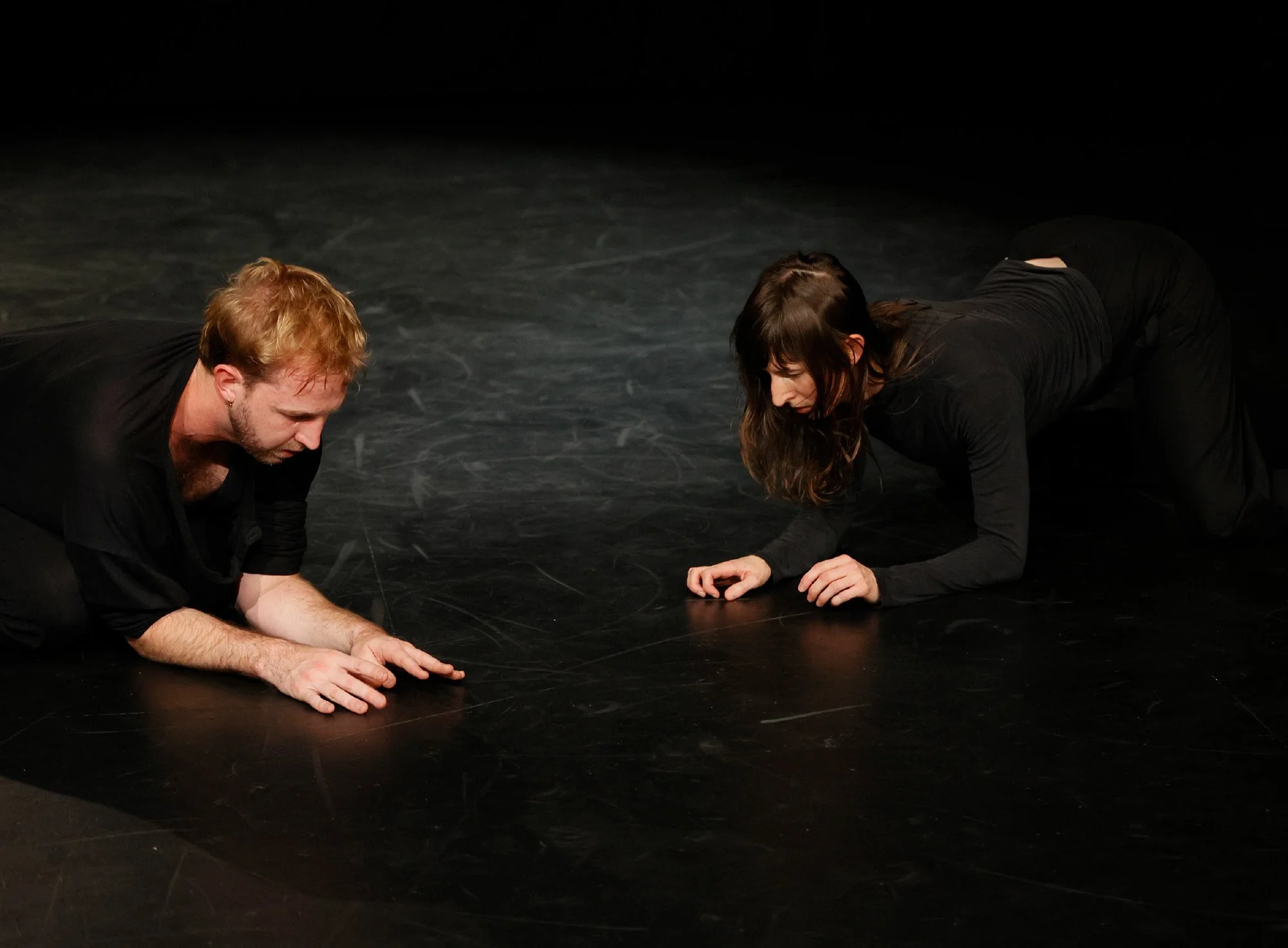
Silver Stocks — Spectating the aftermath
Wednesday 19th August, 2026
Sylvia Staehli Theatre
Dancehouse
Lead Artist, Choreographer and Performer: Alice Dixon
Performer and Collaborator: Geoffrey Watson
Costumes: Alice Dixon and Geoffrey Watson
Sound Design: Robbie Downie
Lighting Design: Jenny Hector
Lighting Associate and Operator: Sam Martin
Presented as part of Dancehouse Season 2, 5th–22nd August, 2026
A Cinematic Pause, my response to Alice Dixon’s Silver Stocks, commissioned by Dancehouse for FIELD NOTES.
FIELD NOTES is a Dancehouse initiative that commissions writers, academics, artists, and culturally engaged thinkers to produce thoughtful, in-depth reflections on works presented within the Dancehouse program. Moving beyond conventional reviews, these texts aim to extend the life of each performance, opening new interpretive pathways, encouraging dialogue, and contributing to a broader conversation about contemporary dance.
In a cinematic pause, a cinematic pause. A pause as expected as unexpected. A familiar scene of Rear Window voyeurism accompanied by the unexpected twinkle of a percussive curtain when brushed. Finding my bearings, familiar landmarks jostle alongside or morph into unfamiliar ones. And so, as I find my seat in the Sylvia Staehli Theatre at Dancehouse on a rainy night, after a three-film-day at the Melbourne International Film Festival, it is only natural, I tell myself, that film scenes from earlier will collide with my impression of the opening of Alice Dixon’s Silver Stocks — Spectating the aftermath.
In the spaces provided or alluded to through darkness, I sketch in the details and find that the films of the day still cloak my form. I have been to Iceland for the funeral of a glacier[i] and a museum for water (featured within Sara Dosa’s Time and Water, 2026). I have been on a farmstead in the Šumavan Mountains, situated near Czechia’s western borders with Austria and Germany (for Miro Remo’s Better Go Mad in the Wild, 2025), with two twin brothers and a bull who gave narration to their days. I have been to Tehran by bicycle and seen scenes rush by quicker than my eye could register, and yet found the rhythm peaceful and green (in Amir Azizi’s Inside Amis, 2025). These three films flow perfectly into Dixon’s Silver Stocks, performed and in collaboration with Geoffrey Watson, in which she is exploring “two traumatic bodily events and violent interruptions [which] profoundly shifted [her] perception of herself and her environment”[ii]. In the cylindrical columns of water, memory is held[iii]. In the twins, two parts of one is held, much like Dixon and Watson. In the blur, structure is found and feeling conveyed. This fourth ‘film’, Dixon’s Silver Stocks, is what has to come next. To discombobulate in the aftermath, “where disruption, disorientation, and disturbance dredge up subconscious memory… [where] the body becomes a site of rupture, persistence, and transformation.”[iv]
Heading into the theatre, directional house lights prevent me from seeing if Dixon and Watson are already on the stage. I lift my hand up to shield my eyes, but the disorientation has already begun. “In 2017, Dixon’s ruptured eardrum led to severe tinnitus and debilitating anxiety. Again, in 2023, a concussion temporarily impaired her cognitive function.”[v] Conversations drop away as people settle into their seats and it dawns, somewhere towards the back of the stage, Silver Stocks is unfurling. Having looked up at the bright overhead lights for too long, I have temporarily hindered myself. The outline of one of the lights appears as a trace image. At the furthest point, in the middle, like a full moon, it shines. And it grows. It has a red nucleus. I think this is the ghost image burnt onto my field of vision, but I cannot be sure.
In the dark, my eyes adjust. I try to see shapes. I am familiar with the space, so I know that it is a large, long hall, with a smaller stage at the end. I know there is a laneway that runs parallel on the left-hand side. I have known anchors and reference markers, and yet I give myself over to the confusion. If earlier I was in an ocean swell of people awaiting a performance, why not stay in the surreal hold of ‘what does this feel like? Where might I be? What lies ahead?’ In the distance, sound emanates, making the theatre feel like it stretches on infinitely. I can picture a bird’s eye view of the houses that surround Dancehouse, but I let myself forget this map, and imagine that the darkness is without limit. As the walls of the theatre fall away, who is to say the same isn’t happening to the nearby buildings and cemetery. Perhaps the darkness is consuming those landmarks as it rolls and extends its reach.
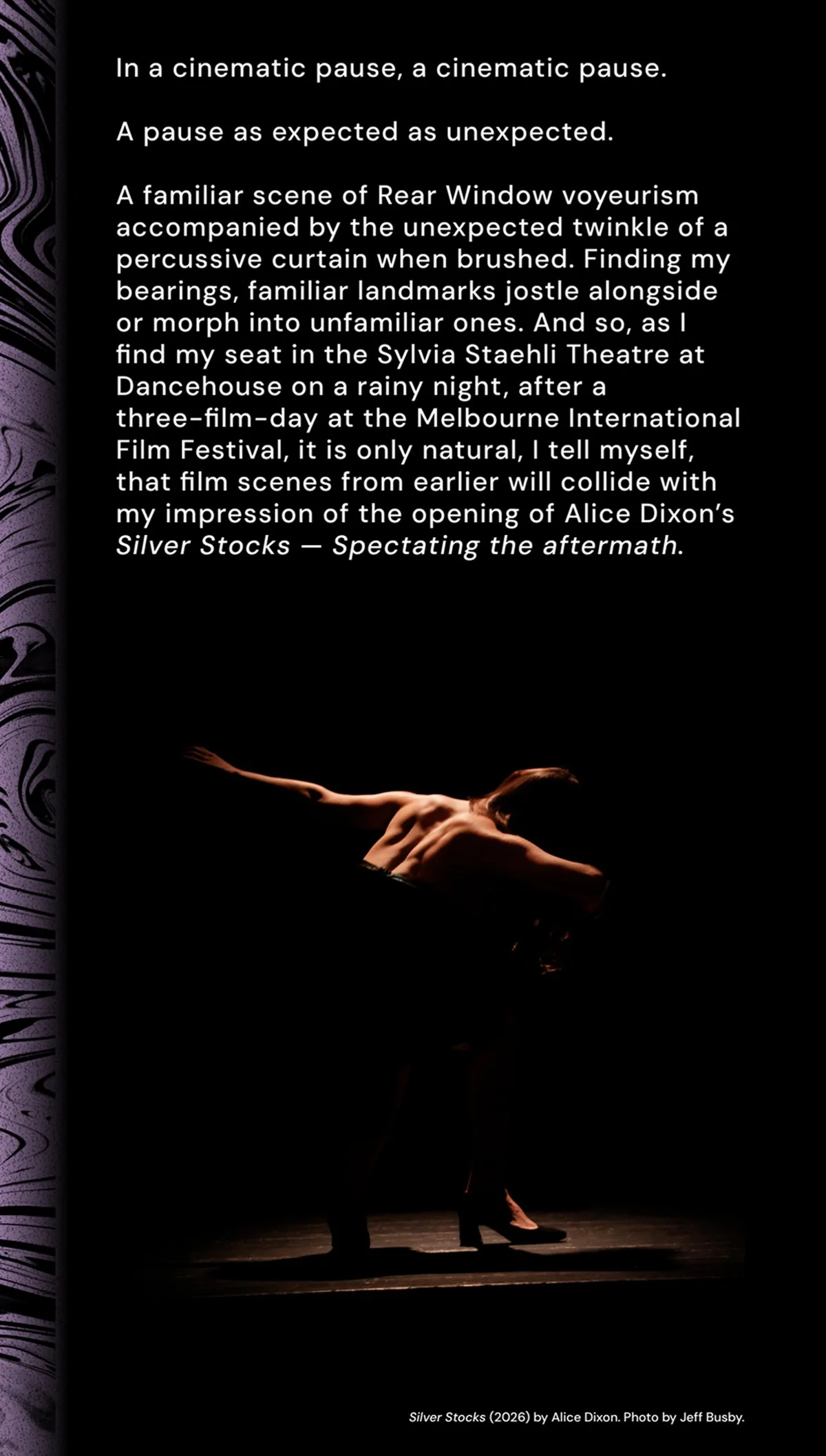
Sounds in the distance (recorded, not actual) suggest an ocean, and there floats Dixon. With her arms extended overhead, her bare arms catch a little of the dim light. Two vertical lines, warm in hue, they remind me of a life jacket. In the controlled revelation, a head, and a little of the legs, I think. The bare elements of the body float in ambiguity, enhanced by sound design by Robbie Downie and lighting design by Jenny Hector, with lighting associate and operator, Sam Martin. Being so far from where I am sitting, I read the arresting blur as an invitation to make of it what I will from where I am. To my inkblot drawing, Dixon’s lower half bobs in the currents, awaiting rescue. I hear the sounds of an aircraft overhead. The helicopter makes the waves choppier, or is Dixon seaweed, drifting with the flow, rather than pushing against it. As land is reached, a squelching sound is heard as a marine algae figure wades ashore. In the darkness, shapes through sound and suggestion appear. In that moment, anything and everything, spectating and speculating.
“Deep into me” sings a voice. “Deep into you” comes the reply. ‘I experience it this way’, posits Dixon; ‘you might experience it that way; go ahead’. The music is overheard as if from a party next door. It is a sound in the absence of an actual party. A car alarm sounds, but it, too, is far away. It is not my concern, and no one around me or on the stage bats an eyelid. A fire alarm sounds, and the same follows. No cause for alarm, no response. It is happening over there, in the periphery. To someone else. Or is it? Next, a gush of water, like when your roof leaks and the outside pours in making everything soggy and unstable. If earlier, a cavernous space, later, a major train station, where am I now, as Dixon and Watson appear, dressed both in black. With a hook-like single finger held to their ears, as if listening for coded instruction, Dixon and Watson alter my understanding of what is real and conjure a playful state of bamboozlement. Mind the gap, forget the drip.
Dixon and Watson, like the twins of Remo’s Better Go Mad in the Wild, move together, but they are also distinctly independent. Standing toe to toe, their bare feet touching, their upper bodies lean back and make a letter V. Dixon attempts to play, poke and point at Watson’s face, and he tries to dissuade her by moving his face away or leaning further back or moving her hands. Elsewhere, when the two of them are on all fours, each with their forearms resting along the floor, they move similar to each other, like the twins, but as Dixon taps the flat of her hand on the ground and walks it over to Watson, he gently nudges it away, or moves it aside. A quick, non-combative correction. A quiet, ‘please, desist’.
With their backs to the audience, Dixon and Watson coil up on the floor in foetal position. In the soft curl, limbs folded in front of their bodies, white arcs of skin are revealed, where the waistband of their black pants and the bottom of their black tops have separated. Pieces of the body bare and exposed, and in beautiful harmony. A curve of moon, each. Twins and fragmentation of form, mirroring once more.
Cue next scene. Dixon walks over to a light standing to the left of the stage and begins to explore its components. She removes the clear disc of the light’s face and holds a pane of distortion. This clear disc, when held up to her face makes her features larger than life, like a fun park mirror of disfigurement. As she scans the audience, her mouth appears in a wide smile that could equally be a grimace. In the double meaning, a funny face is a sad face. In the game of change the context, what’s funny is a tragedy, laugh until you cry, cry until you wheeze with laughter. Where you catch the two sides of the one coin is up to you. The magnifying lens is also a shapeshifter.
True to such, Dixon proceeds to use the disc, once affixed back on the light, as a torch. With it, she scans the room and illuminates the source of one of the water-lapping noises. Watson, lying on the floor like Narcissus admiring his own reflection, in the drip-drip-drip of the earlier rainfall puddled on the floor, is momentarily held in the light. Caught in a compromising position, he stealthily turns from view. In an unguarded moment, what else is there to do? I am reminded of a scene which played out earlier at home when I walked into the kitchen and looked up at the gap between the wall and the roof. At the top of the column, in the weird gap where a vine often sprouts, a rat stuck his or her head over the lip and peered into the room. Not expecting to see me, they ducked back down. They timed their movement so as not to draw further attention. Just a slow and steady, ‘later’. This sensation is in Watson’s rotation away from the beam of light Dixon is attempting to hold him in. He scales the stage, cover blown, for now, but with a promise to return, as Dixon continues to move as if through her an excess of energy is mounting.
Chasing sound and the spatial distance it can create continues as Dixon uses the torch to pursue a second type of animal. In the large airduct overhead, a scurrying sound is heard. She follows the sound of paws upon a metal surface. In the darting movements she makes as she chases the sound, trying to locate the animal in the duct, something of a parallel. In the duct, an animal, like a rat, perhaps a possum, navigates an alien space. Unseen, but definitely there. In hearing something and seeing him or her as if through a surface material, distance and divide is addressed. What does a sound look like? When you listen to a sound behind a wall or in this case, issuing from an overhead duct, what does the sound-maker look like? Is it an animal? A ghost? A branch? A figment of the imagination? Let the imagination loose, Silver Stocks is a reflective portal.
For her next magic trick, Dixon disappears and becomes a curtain. The long black curtain absorbs her and afford a costume change. As she proceeds to position two transparent screens side by side, she draws the curtains so as to frame the screens, giving the appearance of an apartment. I rewind to a scene from Alfred Hitchcock’s Rear Window (1954), and the focus on what is happening inside the room. Dixon, standing outside the room, uses the standing light to direct the scene. She can turn the lights on and off as she chooses. She is the director of the film, determining what her audience will and won’t see. She can cast the scene into total darkness and reveal a new scene each time. Inside the apartment, Watson plays along. He goes through a series of still poses, leaning into the cinematic; a murder mystery corpse, one scene, a Grecian statue, the next. In this game of scene change, freeze, Watson is also calling the shots, as he revels in a series increasingly comic poses.
Of little consequence, be it fire alarm or Watson collapsed on the floor, holding the innate survival freeze position, Dixon puts on her heels, and strides across the stage to the piano. To the strains of (what could be) an electronic lamb bleating, Watson, revived, rushes at the wall as if to scale it like a mountaineer or mountain goat or microbat. He lands atop a six-bank of power-points and with an arm wrapped around a shallow column attempts to flutter and lift, scaling the impossible surface. Not a mountaineer after all, nor a mountain goat nor micro neither. The curtain from the back wall magically inches closer, closer, as if an animate form; it has come to close in around him. Curtains, literally, you’re time is up. And there she ends. Dissolving into darkness once more. Some things are inescapable.
[i] On the 18th of August, 2019, Iceland held a public funeral for Okjökull, the country’s first glacier lost to the climate emergency. A glacier is defined by movement, and in 2014, the decision was made that Okjökull was no longer a living glacier. As Oddur Sigurðsson, a glaciologist with the Icelandic Meteorological Office, outlined: “it was only dead ice, it was not moving”. ‘Iceland holds funeral for first glacier lost to climate change’, The Guardian, 19th August, 2019, https://www.theguardian.com/world/2019/aug/19/iceland-holds-funeral-for-first-glacier-lost-to-climate-change, accessed 20th August, 2026.
[ii] Alice Dixon, Silver Stocks — Spectating the aftermath synopsis, Dancehouse, https://www.dancehouse.com.au/whats-on/silver-stocks, accessed 19th August, 2026.
[iii] The credits of Time and Water reveal the museum in question to be Roni Horn’s multi-faceted installation Library of Water. Horn realised Library of Water, also known by its Icelandic title Vatnasafn, in the small town of Stykkishólmur on the southwest coast of Iceland. Icelandic Art Center (Myndlistarmiðstöð), https://www.icelandicartcenter.is/venues/roni-horn-library-of-water, accessed 20th August, 2026.
[iv] Alice Dixon, Silver Stocks — Spectating the aftermath synopsis, Dancehouse, 2026.
[v] Alice Dixon, Silver Stocks — Spectating the aftermath synopsis, Dancehouse, 2026.
FIELD NOTES
Dancehouse commission: deep reflections on dance works
Rather than simply summarising or judging a performance, FIELD NOTES positions Dancehouse as a site of critical reflection, knowledge production, and cultural memory, supporting sustained engagement with choreographic practice and its wider cultural resonances.
A Cinematic Pause
— a written reflection on Sliver Stocks by Alice Dixon
by Gracia Haby
Gracia Haby is an artist and wildlife carer who works collaboratively with Louise Jennison, and she is also fond of collaging with words.
Image credit: Alice Dixon and Geoffrey Watson in Silver Stocks, by Jeff Busby
