Of parts, still moving
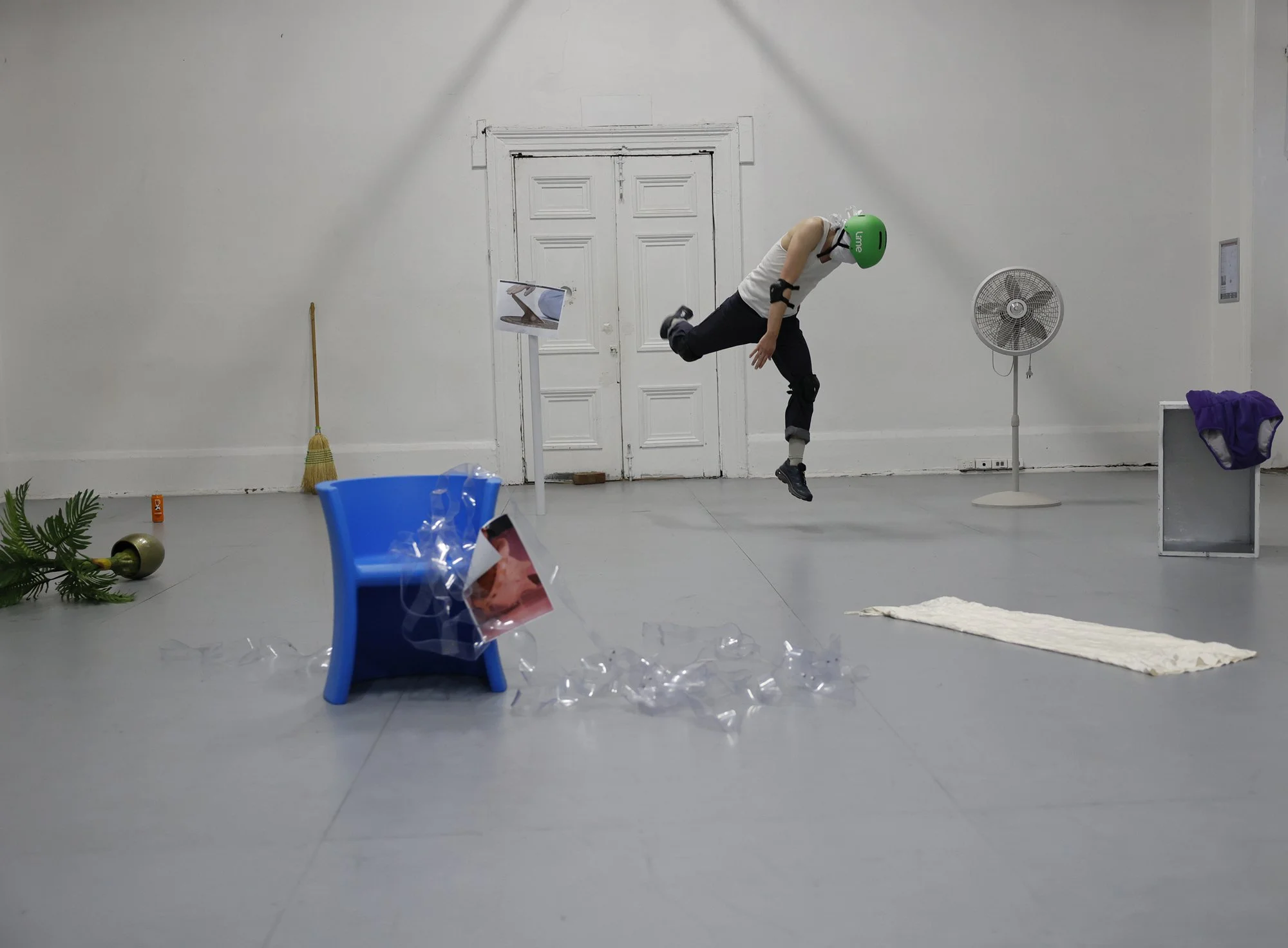
Slapdash (work-in-progress)
Oliver Savariego
Friday 1st May, 2026
Temperance Hall
199 Napier Street, South Melbourne
Created and performed by Oliver Savariego
Performers: Oliver Savariego and Robert Downie
Sound: Robert Downie
Dramaturg: Marcus McKenzie
Studio consultant: Rikia Bell
Artists stolen from: Andrew Treloar, Angela Goh, Anne-Marie May, Antony Hamilton, Atlanta Eke, Babette Mangolte, Boris Charmatz, Charlie Lee, Darren Gill, Deanne Butterworth, Dinu Corminboeuf, Eero Aarnio, Gemma Sattler, Gideon Obarzanek, Harrison Ritchie-Jones, Isadora Duncan, Jeff Busby, Jessica Goodfellow, Jo Lloyd, Julianne Moore, Justin Bieber, Kylie Minogue, Lee Osmond, Loie Fuller, Luci Young, Lucy Guerin, Lucy Guerin, Marcus McKenzie, Melanie Lane, Melati Suryodarmo, Michel Gondry, Molly McKenzie, Nana Bilus Abaffy, Oliver Savariego, Paul Thomas Anderson, Peter Rosetsky, Phillip Adams, Pina Bausch, Rafael Bonachela, Rebecca Jensen, Renata Sorrah, Rikia Bell, Robert Downie, Sandra Parker, Sarah Aiken, Shelley Lasica, Stuart Shugg, Trisha Brown, William Forsythe, Yvonne Rainer
Choreographic Collage, my response to Oliver Savariego’s Slapdash (work-in-progress), drawn up especially for Fjord Review.
Oliver Savariego presents a collage of parts still moving, and perhaps ever destined to always be so, in a new solo work-in-progress, Slapdash, at the conclusion of his Front Studio Residency[i] at Temperance Hall. A one-night-only revelation, Savariego’s Slapdash self-portrait plays with sequence and the layering of personal meaning, in what he describes as “a choreographic collage of stolen materials… corrupted through recollection, iteration, translation and digitisation”[ii].
Serving as quite the allurement, Slapdash, in its current form, is billed as featuring works “stolen” from a long list of artists, some of whom are seated in the audience, others further afield or from the history books. Angela Goh, Antony Hamilton, Atlanta Eke, Babette Mangolte, Boris Charmatz, Deanne Butterworth, Harrison Ritchie-Jones, Isadora Duncan, Jo Lloyd, Justin Bieber, Kylie Minogue, Loie Fuller, Lucy Guerin, Melanie Lane, Michel Gondry, Nana Bilus Abaffy, Phillip Adams, Pina Bausch, Rafael Bonachela, Rebecca Jensen, Sandra Parker, Shelley Lasica, Trisha Brown, William Forsythe, Yvonne Rainer and more besides. The roll call, varied and impressive, leads me to look for the artists’ hallmarks. Will they be clearly signposted or more abstract? And given that this collage is embedded in the personal: does it matter if I miss them in the rip and slip-slide of the process?
In the inkblot of association that forms, I am reminded of Keith Arnatt’s reductive dematerialisation in Self-Burial (Television Interference Project) (1969), in which “one photo was shown each day, for about two seconds, sometimes interrupting whatever [TV] programme was being shown at peak viewing time”[iii]. Just like some of the references within Slapdash, they were neither announced nor explained, with the onus on the viewer “to make what sense of them they could”. A “periodic interference” aiming to kindle a sense of “what’s going on” bemusement, out-of-context creates a new context. The nature of Arnatt’s imagery (nine photographs popping up on TV) converges with the nature of television, and a sense of this is in Slapdash. For Savariego’s work-in-progress is also about his own nature and the machine, and where the two realms intersect, and what traces, if any, are left behind.
As Savariego describes in the Q&A session, which follows the performance, to him, the tangible space of his real life differs to how he inhabits online spaces. In such spaces, “technical elements are corrupting the material”, and so Slapdash is an exercise in trying to shed the layers, and reduce the material. What begins as a repetition of steps in near-silence carries with it a “sense of worry and dread”[iv]. Watching Savariego repeat sequences, the only audible sounds are his effort, which is deliberately not hidden from the viewer, and that of the click, click of the photographer documenting the process, standing to the side of where I am sitting. It comes as a relief when Savariego breaks the silence, but this relief is quickly dispelled for the noise is generated by him repeatedly beating his own chest until it appears red. Each thud to the heart weighs heavily: “at the beginning I exist as an object, not as me”. In shedding the layers of performance to reveal a “motely assemblage of influences” vying for attention, the process was alluded to upon entry, and “rips, crumples, cuts, shoves”[v] take on meanings independent to collage. In the performance or recording of a deliberately uncomfortable process of self-judgment and harm, in one, and burial in the other, a further way that relates Savariego’s Slapdash to Arnatt’s nine photographs, to me, emerges.
In Slapdash Savariego address the perceived shortcomings of the body’s ability and fatigue, and the shortcomings and reliability of the copy of a copy. In the degradation of an image copied several times over, physical abrasions occur. In the digital realm, this ‘generation loss’ accumulates, and like the lossy format of the JPEG, Savariego, runs through his steps, altering bit by bit. The body, too, is an exhaustible machine. A packet of Dorritos is opened.
Click, search, copy. Black, white, and silent, Babette Mangolte’s Trisha Brown WATER MOTOR (1978) materialises on the far wall, thanks to a YouTube upload. Having earlier nonchalantly headed over to the laptop and searched, Savariego now has Trisha Brown to both learn from and rehearse with. Recalling “both the flow of water and the intensity of the motorised engine”[vi] Savariego leans into this juxtaposition of the two states, evident within the projected archive and felt within the known material.
Slapdash, in this guise, is the very opposite of lackadaisical.
[i] Temperance Hall’s Front Studio Residency offers six independent artists an artist stipend and two months of exclusive, unrestricted access to the Front Studio at Temperance Hall. At the conclusion of their residencies, artists present a public showing of their work in development, and receive professional photographic documentation.
[ii] Oliver Savariego, Slapdash, Temperance Hall website, https://www.temperancehall.com.au/events/slapdash-oliver-savariego/, accessed 2nd May, 2026.
[iii] Keith Arnatt’s Self-Burial (Television Interference Project), 1969, The Tate, https://www.tate.org.uk/art/artworks/arnatt-self-burial-television-interference-project-t01747, accessed 2nd May, 2026.
[iv] Paraphrasing from memory of Q&A session, Temperance Hall, 1st May, 2026
[v] Oliver Savariego, Slapdash, Temperance Hall website.
[vi] Babette Mangolte, Trisha Brown WATER MOTOR, 1978, https://www.tate.org.uk/art/artworks/mangolte-trisha-brown-water-motor-t14764, accessed 2nd May, 2026.
Subscribe to and support Fjord Review.
Fjord Review is a world-class review of ballet and dance. Edited by Penelope Ford, Fjord publishes original dance criticism, interviews, features, essays, photography, and hosts the podcast, Talking Pointes, a bronze medalist for the Best Arts & Culture podcast by the Australian Podcast awards in 2022. Our contributors, based in five continents, are dance scholars, critics, artists, and emerging voices united by a passion and gift for illuminating dance. In 2018, Fjord was nominated for a Canadian National Magazine Award for excellence in digital publishing, and since 2019 we have published a biannual print magazine.
Fjord Review reaches over a hundred thousand readers each year, and delivers a weekly dance digest newsletter to thousands of dance enthusiasts each week. Whether you are a self-confessed balletomane or new to dance, we hope you find a companion in Fjord Review.
Image credit: Oliver Savariego in Slapdash (work-in-progress), by Jeff Busby
