Sanctuary
Tiny but Wild Keynote
Sanctuary Keynote guests: Gracia Haby & Louise Jennison
Art Education Victoria Presents: Re-assemble Art Education Conference 2026
Storey Hall, RMIT University, Building 16, 336–348 Swanston Street, Melbourne
Friday 10th July, 2026
Through our artwork and our care work, as artists and wildlife careers, we seek to illuminate the many and wondrous ways in which the more-than-human or the other-than-human beings experience, sense, and perceive the world. When we pay attention to other beings and unseen but sensed energy forces, like rivers, mycelial networks, trees, the wildlife around us, side by side, the interconnectedness of all things is apparent.
Sometimes our artwork informs our care work, but more often than not, it is the other way around. Sometimes they are two different lands, and sometimes they reveal themselves to actually be the same thing, originating from the same source. We encounter the effects, firsthand, of human encroachment into wild habitats. And we try to pour the consequences of this and potential solutions to this, in turn, into our artwork.
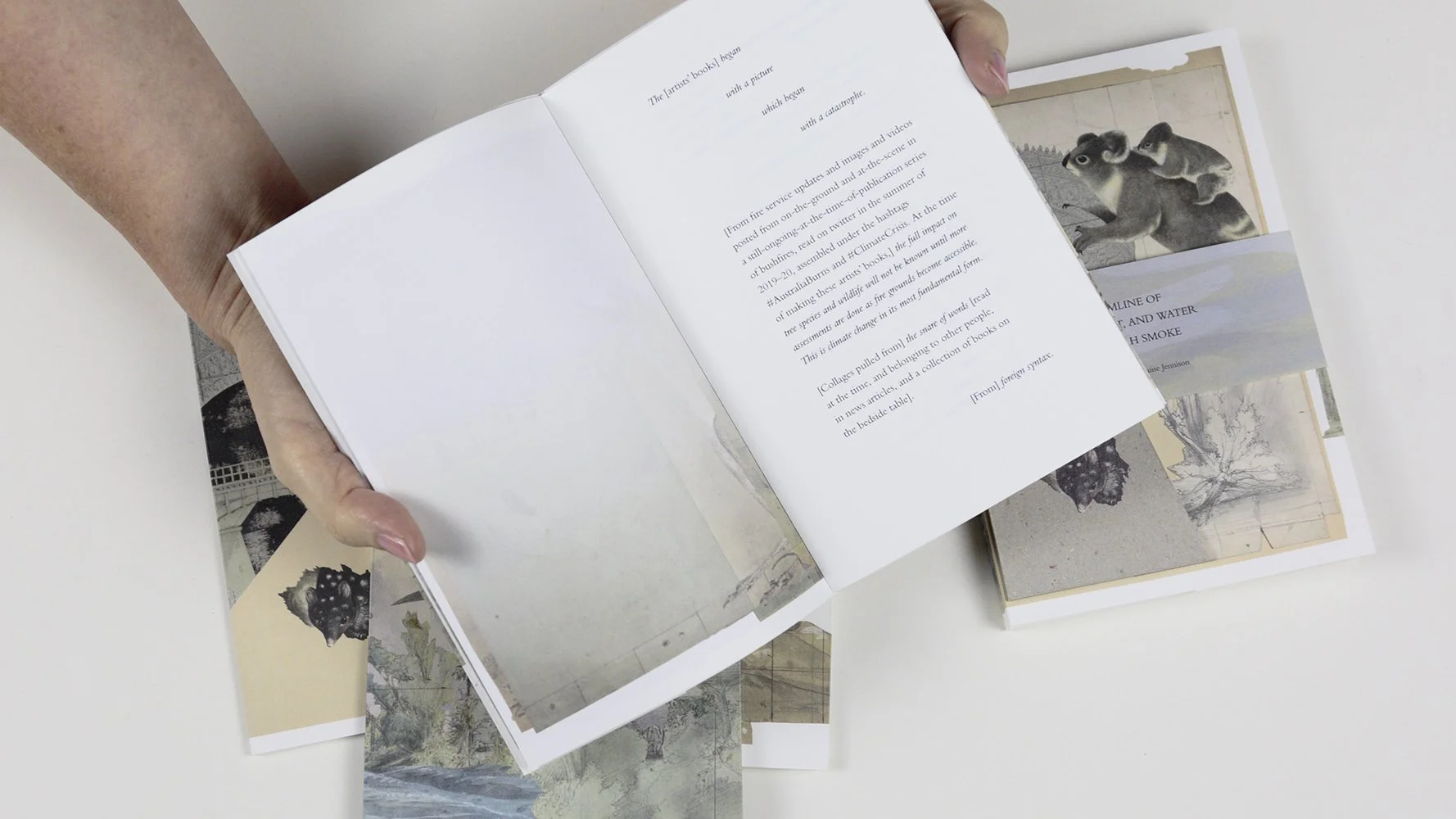
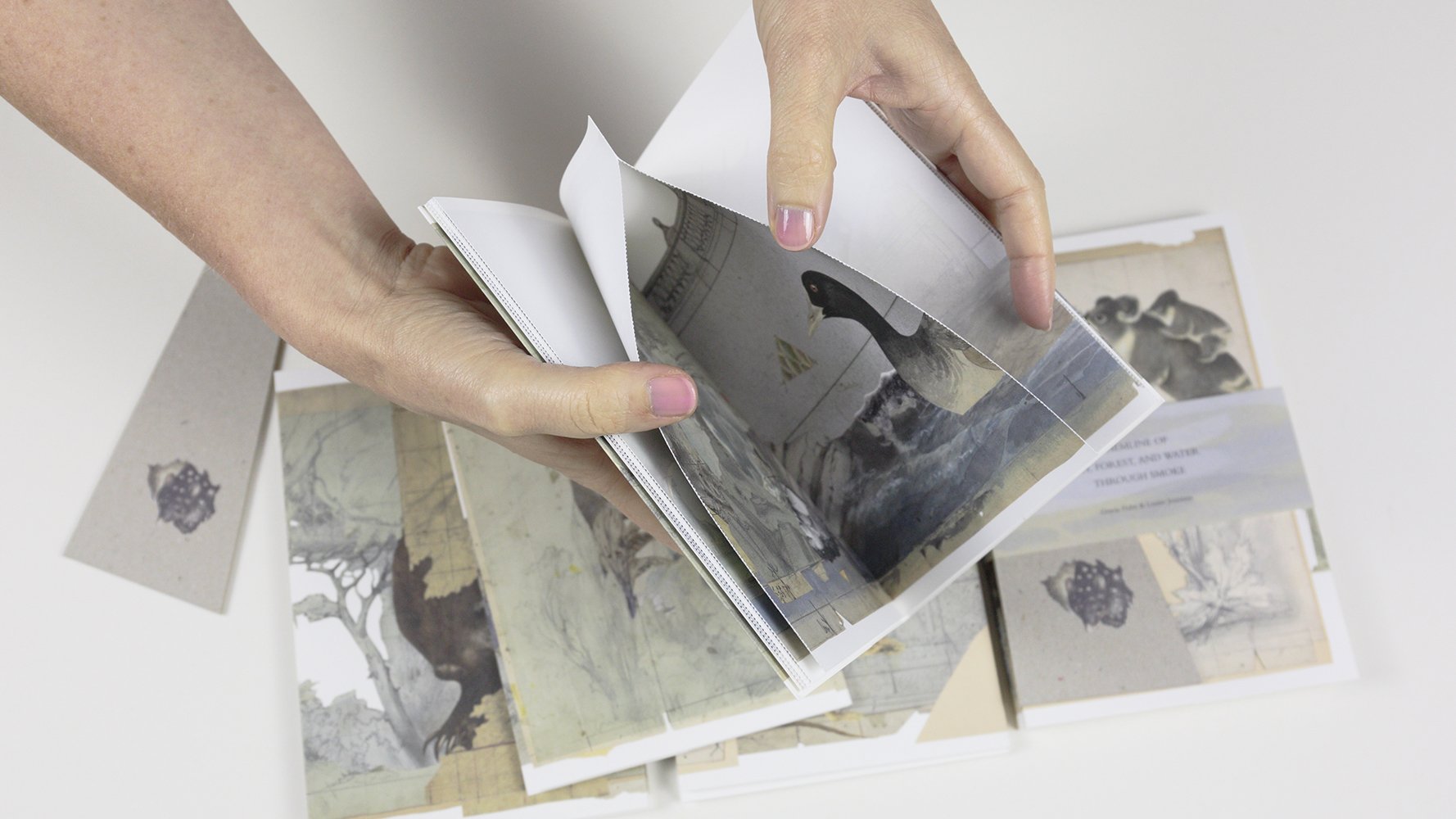
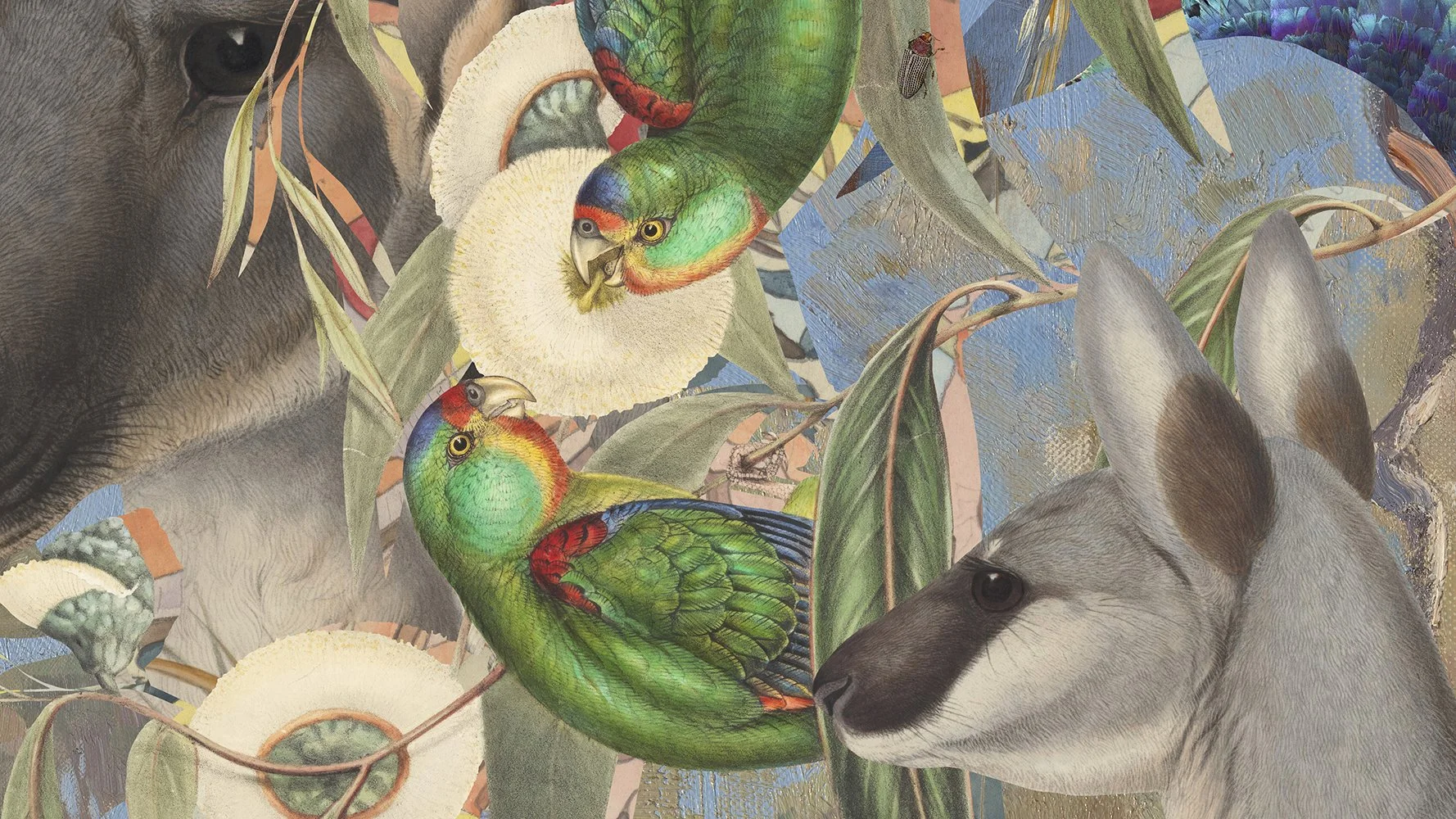
One such example is our Hemline series of artists’ books, created in 2020, in response to the megafires. A Hemline of Sky, Forest, and Water Through Smoke are bound on the fore-edge. Each of the titles is an edition of 100, and they require the reader to ‘take action’ in order to see the full collage. The reader is invited to tear open the perforated fore-edge of each page spread to see through the smoke, to see what lies beneath, or ahead, or in the past. From the critically endangered Swift parrot (Lathamus discolor) to the vulnerable Long-nosed potoroo (Potorous tridactylus), all of the species within the pages were once common, where and when they were initially observed and later drawn. To us, the hemline of smoke in the collage is both a representation of bushfire smoke, and a reference to the disappearance of the natural world due to land clearing, species extinctions, and the climate change emergency.
To date, we have released into the wild 112 artists’ books (some unique state, and others, editions of anywhere between two to 100), and 158 zine editions (three of which are digital-only, released as free digital downloads). And, as licensed wildlife carers, we have cared for 284 wild souls.
❧
The word sanctuary, or sanctuarium, has its roots, as Samuel Johnson’s famous dictionary tells, of being “a holy place; holy ground”[i]. A site of restoration, perhaps one we can retreat to, for a spell, but more importantly, one we can emerge from with a clear head, a questioning mind, and wide eyes. So, for us, if you need to go inward, it is in the service of then looking and being outward.
To us, then, what is sanctuary and what does looking, or being outward-facing, mean? Our wildlife shelter, Tiny but Wild, is a place of restoration for the wildlife in our care. But it, too, is always with a view to release, either back to habitat, or a release from suffering. Our work is helping them to mend, through rest, rehabilitation, treatment, and, in the case of pups or joeys, raising them until they are old enough to be released home, it is about giving back to them that which was taken from them. The shelter might appear to be a short- to longer-term sanctuary, but the release, the return home, to habitat, to the wild, is the aim we both share. And so sanctuary is not within but beyond us. Sanctuary is the moment of return to the wild, where they are meant to be. An interconnected puzzle piece returned now either healed or raised.
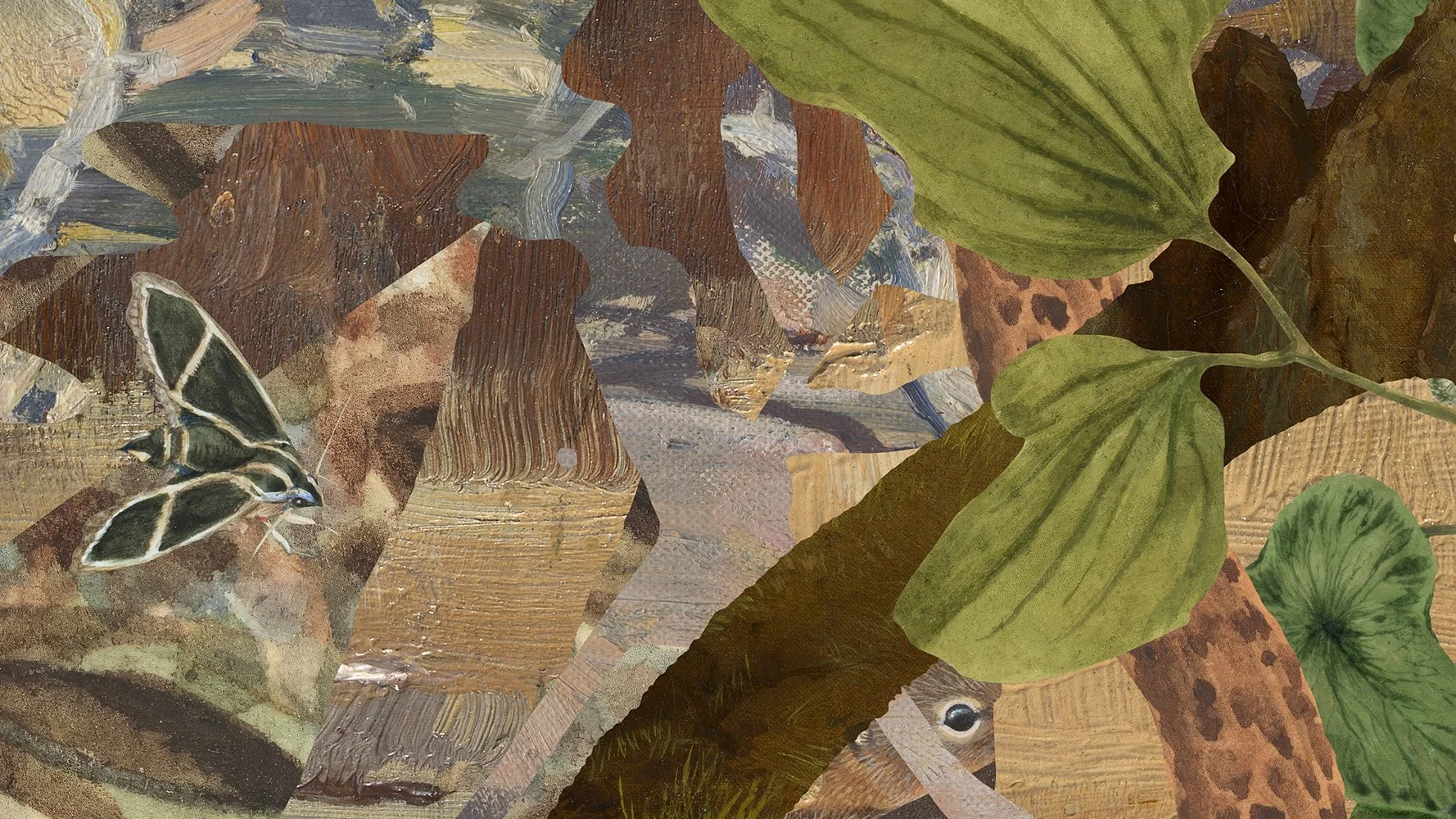
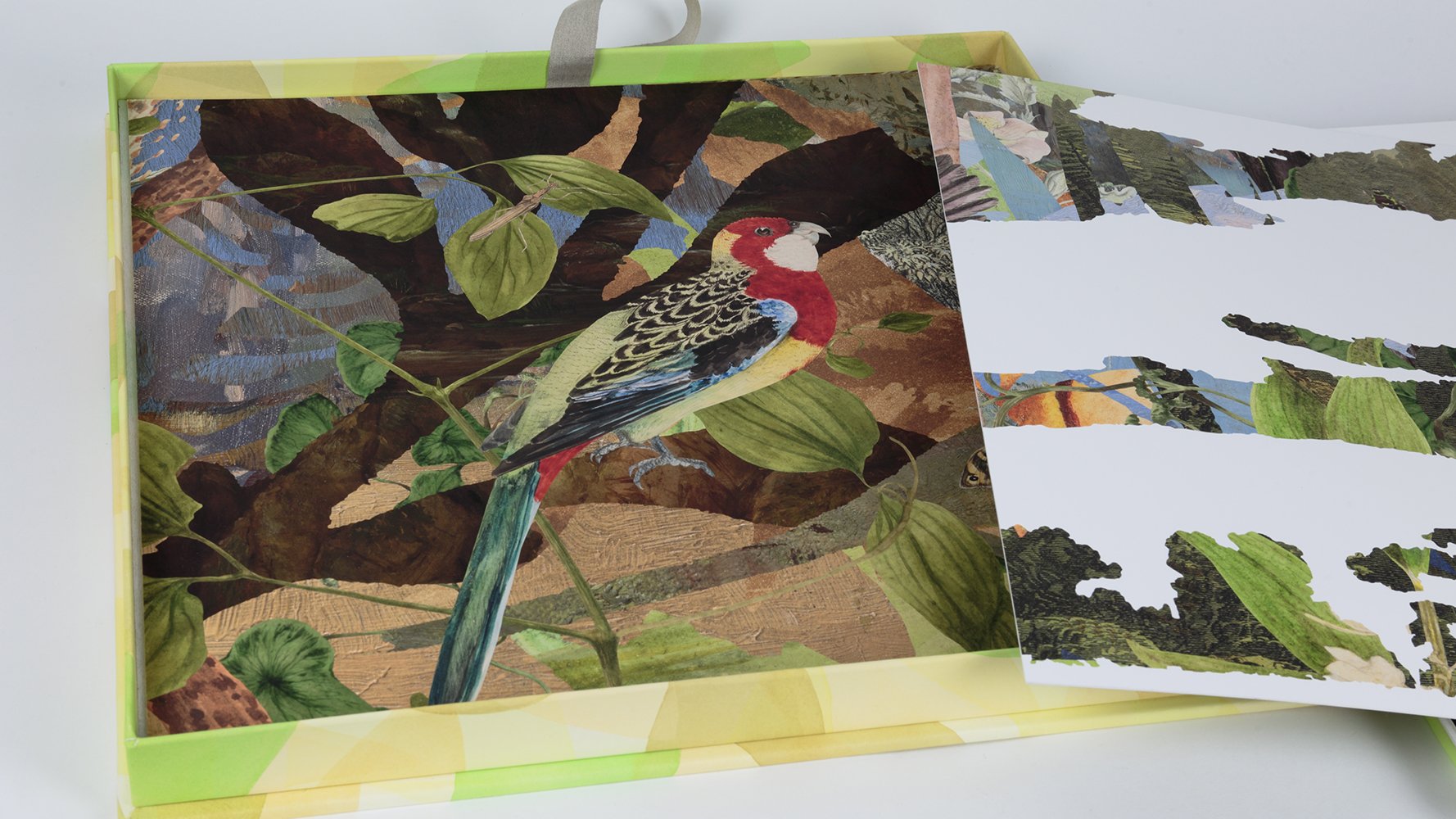
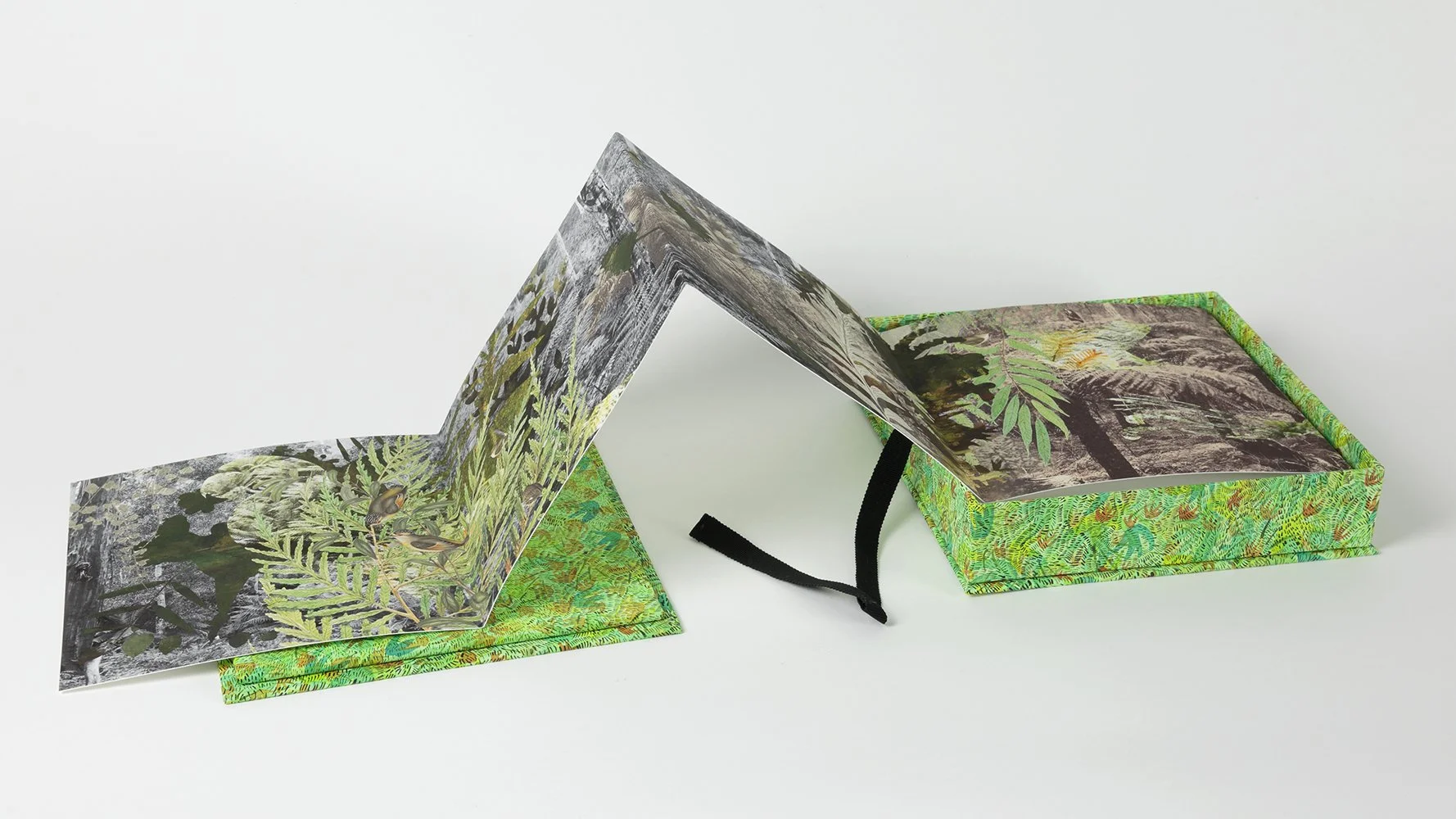
Restoring corridors, our unique-state artists’ book from 2024, currently on display at Hawthorn Art Centre’s Town Hall Gallery, as part of Slow Read, an exhibition for the love of books “in an era of constant scrolling and visual saturation”[ii], and presented in partnership with the recent Melbourne Writers Festival, is one such example of this. A multi-panelled, double-sided artists’ book that forms an interchangeable, reversible slice of biodiversity in flux, the reader is invited to step up and this time ‘turn the pages’. Will you actively participate and contribute to biodiversity restoration or allow for habitat to be isolated, further dissected by human pressures[iii]? In this work, piece by leaf, you, the reader, can connect and strengthen green corridors to habitat, ensuring biodiversity can flourish. Turning each 50cm x 50cm leaf, one by one, this act of regeneration can be read in multiple states of growing, as wild animals return and pollinators thrive. Housed in a handbound box made from large watercolour paintings (2.5 metres in length), our working process is near always labour intensive.
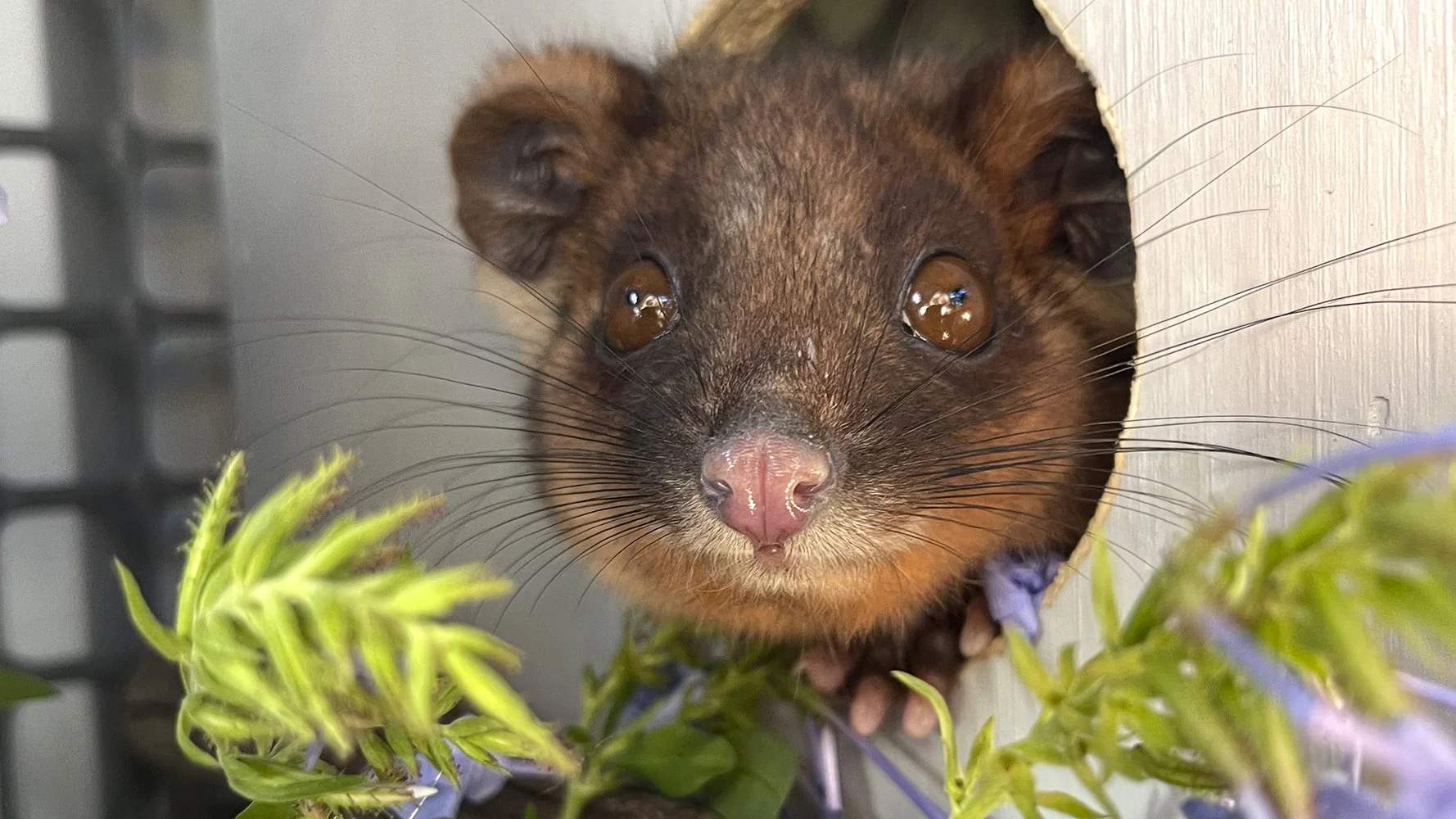
The work is accompanied by the text, ‘A good soft-release site is a connected site’, which outlines our ringtail possum soft-release program. Since 2022, the two of us, and some wonderful friends, we have safely, softly released over 40 possums, inclusive of two brushtails, Myrtle and Poppy. And, as we speak, we are in the midst of soft-releasing a quartet at Sutton Grange, Echo, Periwinkle, Asta, and Gustave.
Understanding their ‘umwelt’, attending to the ‘life-worlds’ of others, requires you to listen, to pay attention. To learn. And works such as Restoring Corridors, and our accompanying soft-release program, are just that. Extended to include a pair of Parry’s Wallaroos, a Black wallaroo, and what was initially documented as a Tasmanian Rat-kangaroo, but is now known as a Long-nosed potoroo, A fleeting sense of, 2026, allowed us to foreground the magnificence we risk losing. This work, also on display at the Town Hall Gallery, was initially created as part of the Metro Tunnel Creative Program. At Scott Alley, as part of the Town Hall Station, we installed A fleeting sense of what could be, a fleeting sense of what was, a fleeting sense of what the world looks like if you could see, like some birds do, ultraviolet (UV) light. This tendril of connectivity was created to commemorate the death of the last Thylacine (Thylacinus cynocephalus) on National Threatened Species Day (7th September, 2025)[iv]. Benjamin died in captivity at Hobart Zoo in 1936.
❧
As Andrew Henry Weber wrote in his essay, Wildness and Wonder: on saving the planet, “What wilderness patiently teaches is that we are part of something much bigger than ourselves, and that there is far more to grasp than what we can see on the surface. Just as all the matter in the known universe barely weighs against the mass of the so-called “dark matter” that we cannot see, so the value of wilderness as a corridor for thought reaches far beyond the material sum of the life it harbours or the natural history it envelops. That is why the ideas and precepts it holds for our future need to be cherished and made a part of our everyday lives, even when those lives are lived—as most now are in cities—in places far removed from wilderness. We need to reacquaint ourselves with the awe and wonder and curiosity that are inherent in our kinship with all life.”[v]
To do so, we take the historian’s long view. We are custodians, stewards. A small blip in the fabric. And in seeing beyond ourselves, something far bigger and more important than ourselves, we see more clearly. So, a sanctuary, to us, is about looking outward, not inward. And of course, by looking we also mean doing, for looking, and knowing, like hope, they are actions. They are active. To be attuned requires it.
Driven by a concern to help others, of course, is akin to many parts of teaching. An awareness of the rich, luminous biosphere, and an openness to the ideas it holds, that goes deeper than what we can see with our eyes — we human beings are so ‘all about the eyes’ — allows us to move past fixed views about how we see and in turn fit into the world around us. Again, to borrow from Weber: “We are starting to see a universe that is continually unfolding new aspects of itself. That is crucial to how we approach the many crises that face our planet… To be in touch with nature is to be included in an intense mutuality, a web of reciprocity stimulating connection with other lives.”
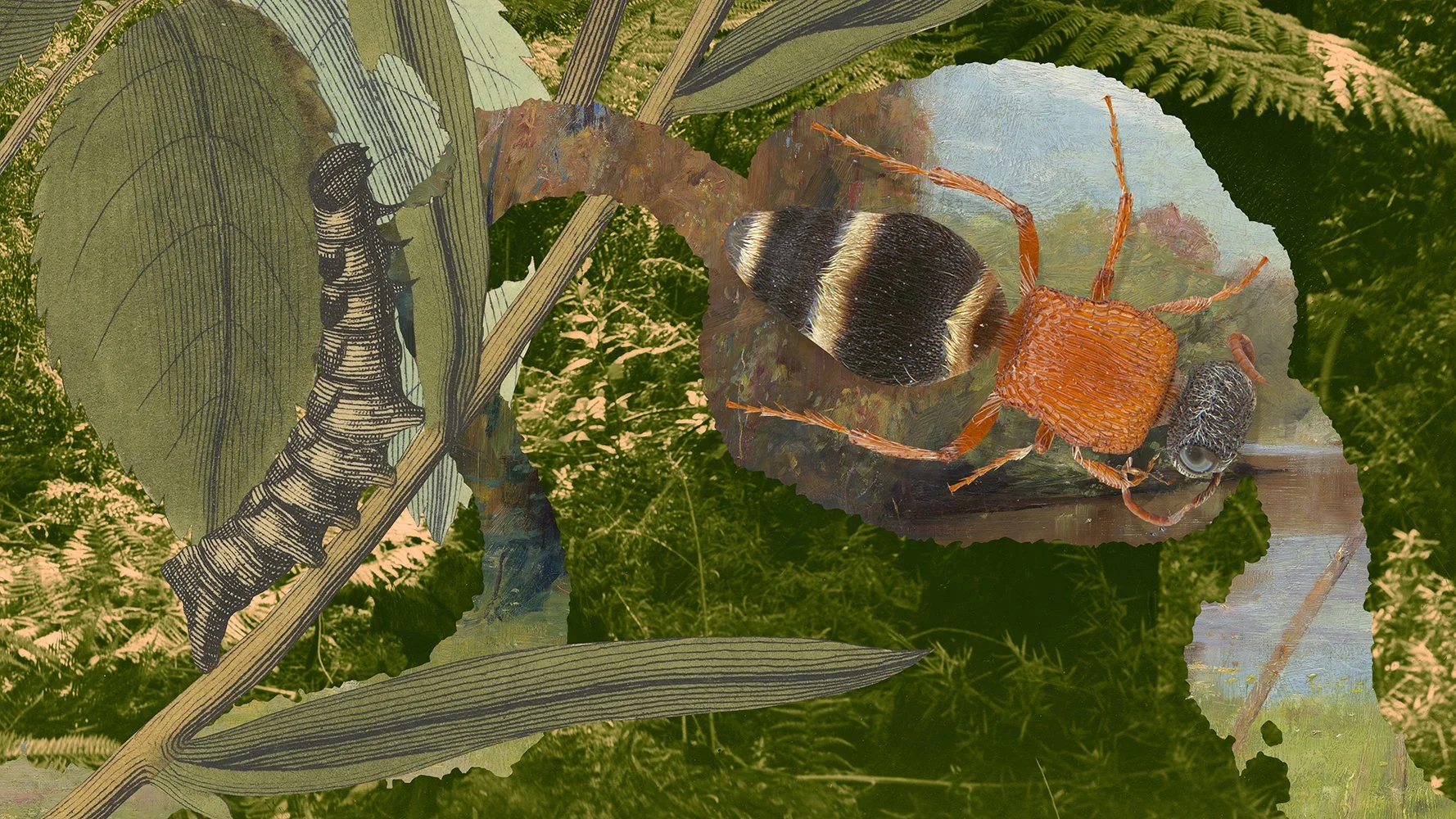
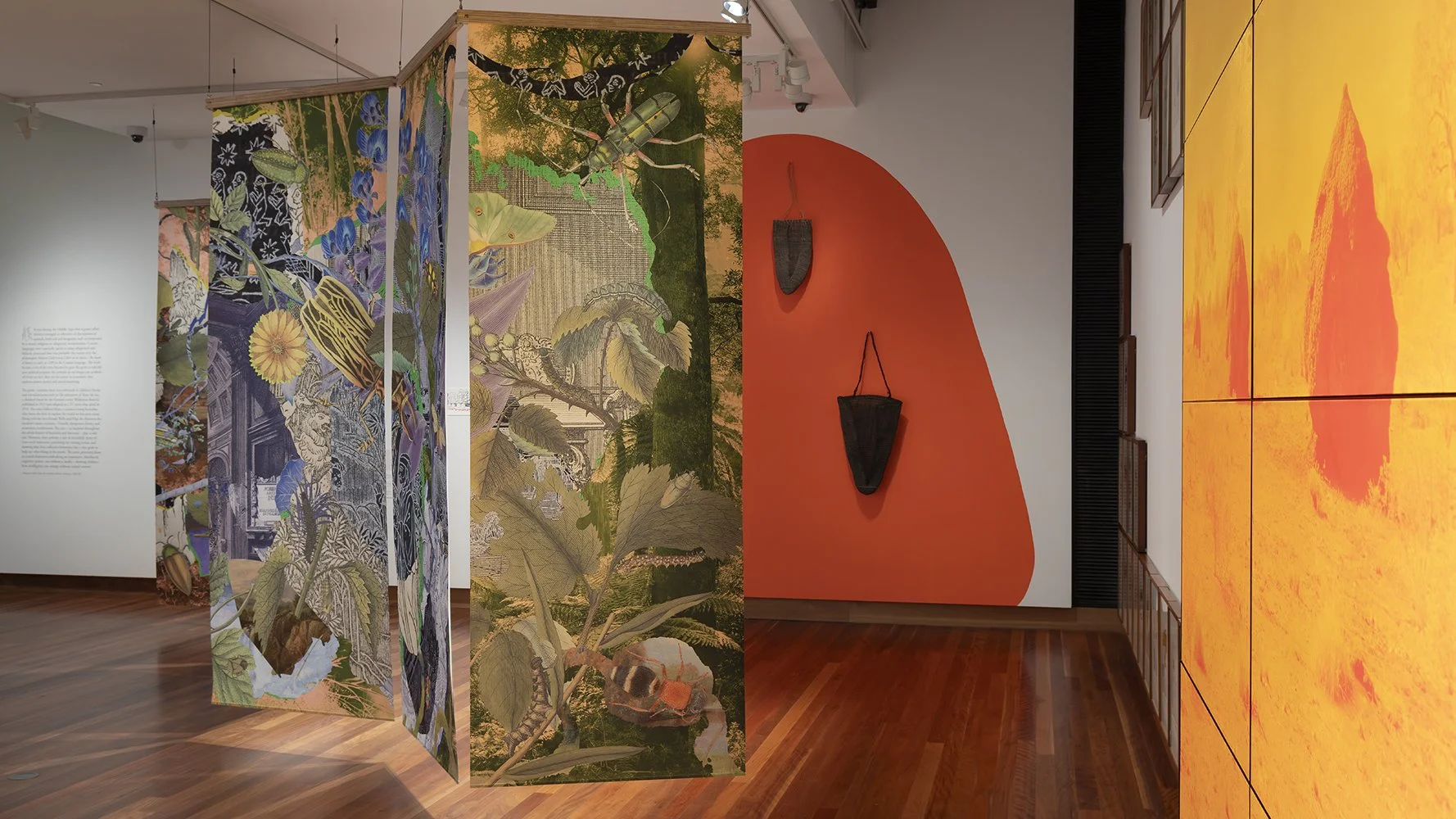
One example of this is our recent work about a female Velvet ant. An ant in name alone, for a Velvet ant is actually a wasp. A wasp who is soft, in appearance only. Specimen 1963, a Potter Museum of Art commission for the recent exhibition, A velvet ant, a flower and a bird, curated by Chus Martínez, takes you into our imagined summation of a single Velvet ant’s world. Across a series of suspended screens, 8 metres in length and 2.8 metres high, our floating concertina can extend or compress. At the heart of the collage, in a host’s nest, lies her egg. And just as she looks for a host, like a cuckoo looks for another bird’s nest in which to leave her egg, we have made a nest from Piranesi’s 1768 etching on laid paper, Interior View of the Pantheon. If you look at a Velvet ant under the microscope, you will see that the wingless female sports armour; armour so strong it is known to break the pins of entomologists. It is what is needed, this armour, if you are going to locate the nest of another type of wasp or bee and, once inside, lay your single egg on the larvae of the host insect. If you were to be intercepted, you’d require armour too; your plans run counter to each other.
Within our work, on the last panel you can see the actual specimen we looked at beneath the microscope, collected in 1963, hence the name of the work. You can see her striated thorax which, to us, resembles amber glass. You might also be able to see her GPS-like lens atop her head, which allows her to see in ultraviolet and polarised light. And her compound eyes that allow her to see 300-frames-per-second, a level of detail impossible to fathom. Next to her, we move in slow motion, for wasps, evolutionary speaking, when compared to ourselves, are so far advanced.
Working with collections of the Baillieu library, State Library Victoria (SLV), and Melbourne Museum, specifically, we comprised a collage from hundreds and hundreds of layers, over a year in the making. The unflattened Photoshop file for this piece was over 60 gigabytes. Every layer, hand-cut, as if it were with paper and scissors, to replicate our ‘by hand’ process. It is an important meditation, too. Another way of looking, up close, and in the abstracted detail, discovering more. In addition to Martínez and those at the Potter, from Charlotte Day to Pippa Milne, this piece required the collaboration of Susan Millard, Curator of Rare Books, at The University of Melbourne; Dr Anna Welch, Principal Collection Curator, History of the Book, SLV; Hayley Webster, Manager, Library, Museum Victoria; and Dr Ken Walker, Senior Curator of Entomology, Museums Victoria Research Institute; alongside digitisation teams who photographed, scanned, and imaged an extraordinary wealth of material with an entomological emphasis. It was a slow, particular, and wonderful process, and it allowed us to delve into the natural history books of Casper Stoll, Edward Donovan, Dru Drury, James Duncan, and more besides.
❧
As Katherine Rundell describes, “we have collided with living things, in both joy and destruction”[vi], and it is what we do next that matters. For “we live in a world of such marvels. We should wake in the morning … [and] scream with awe, but for that, we’d need pay attention.” And this, this calling attention to, or shining a light upon, is one of the ways we can advocate for nature, for wildlife, for habitat, both its restoration and protection. Because what we see, sense, recognise, stand in awe before, we also come to love.
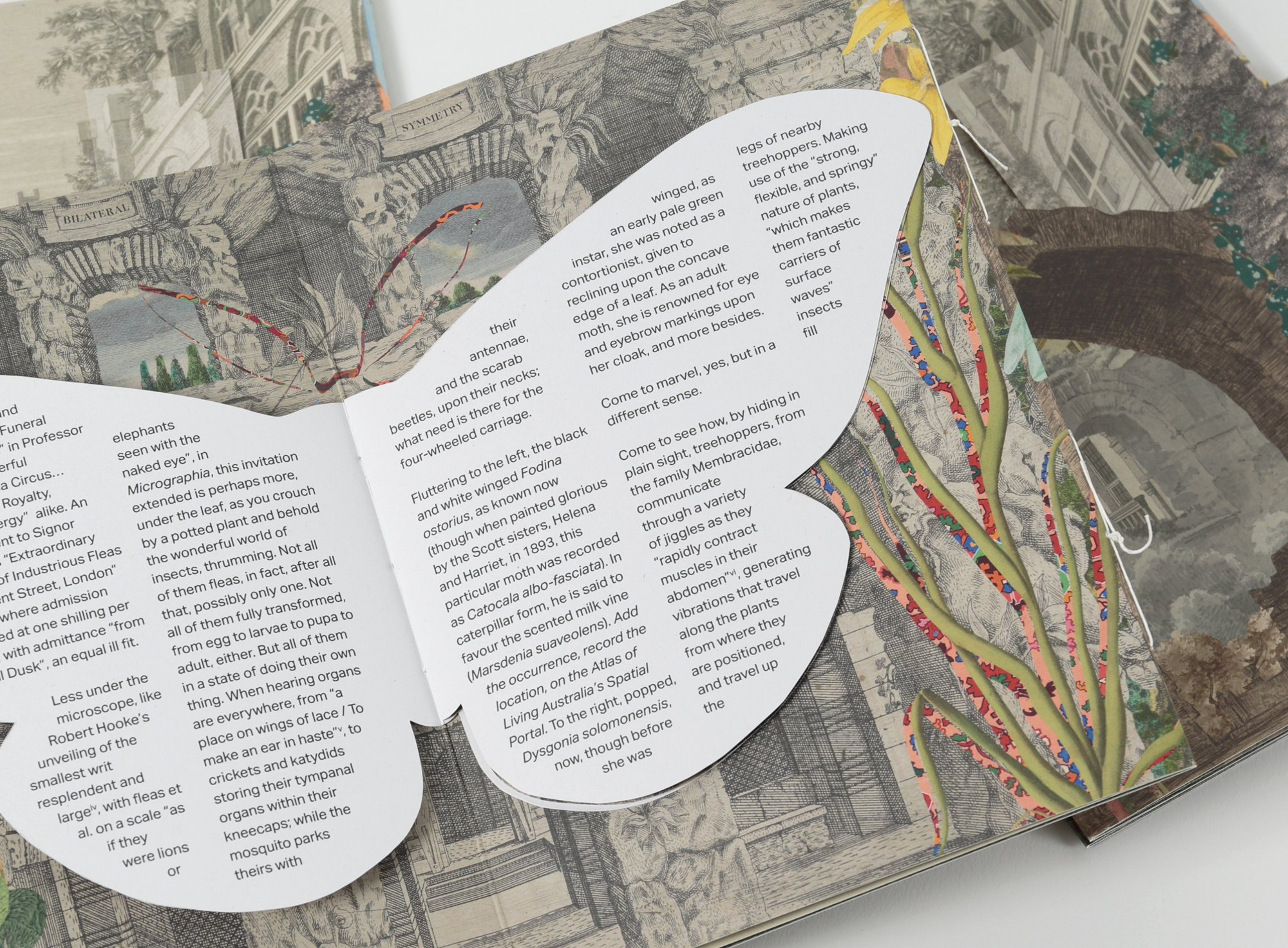
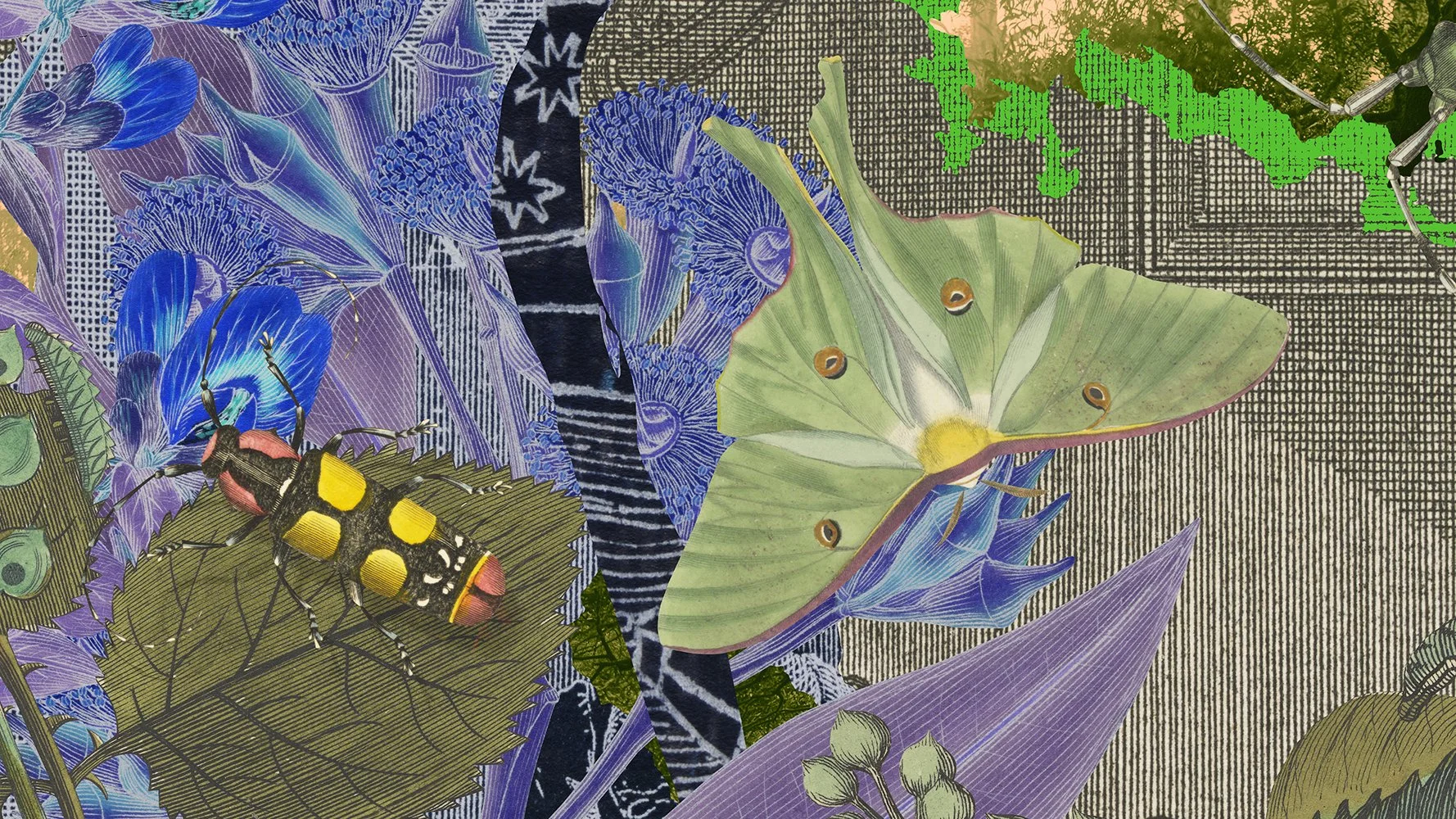
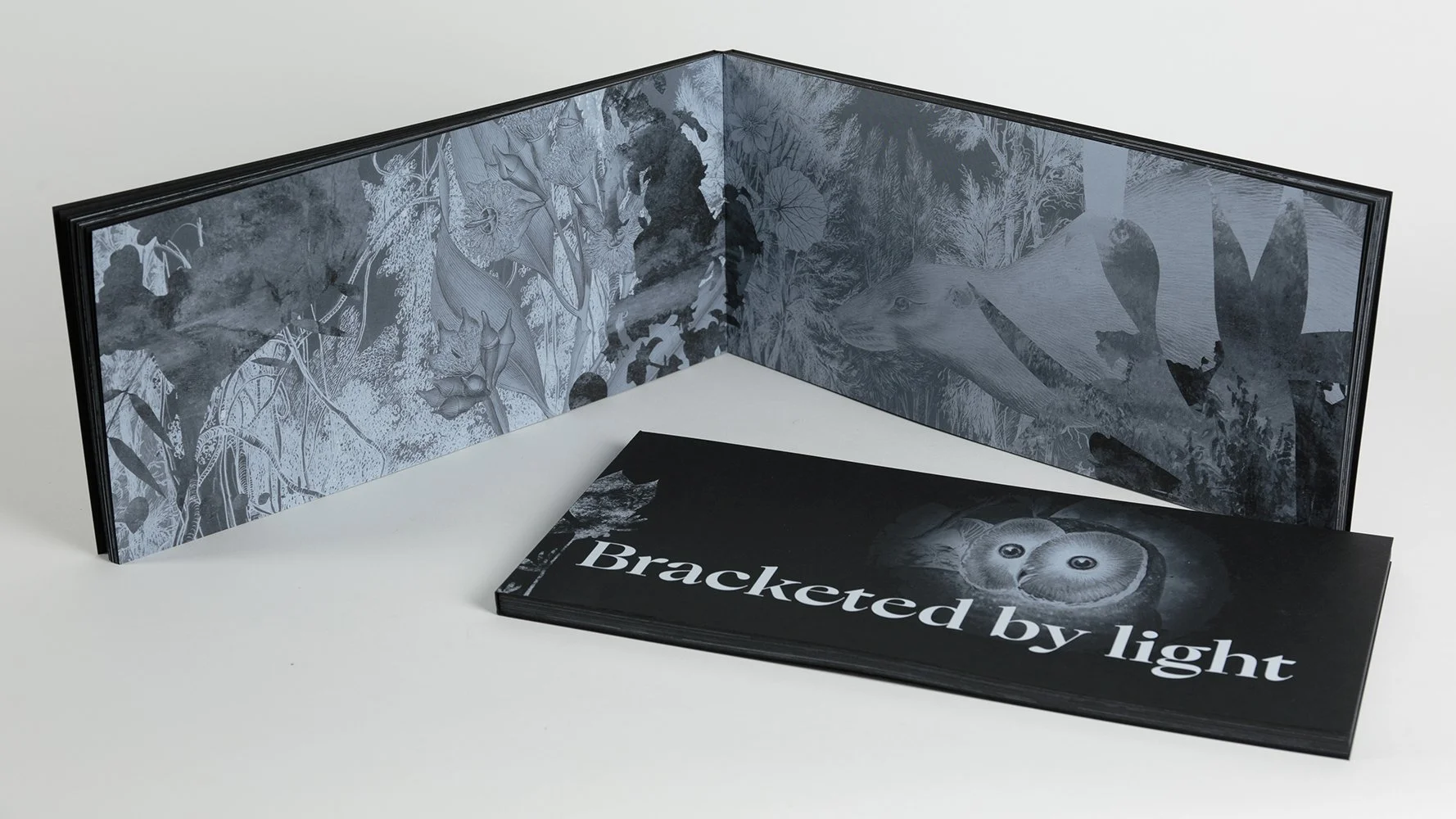
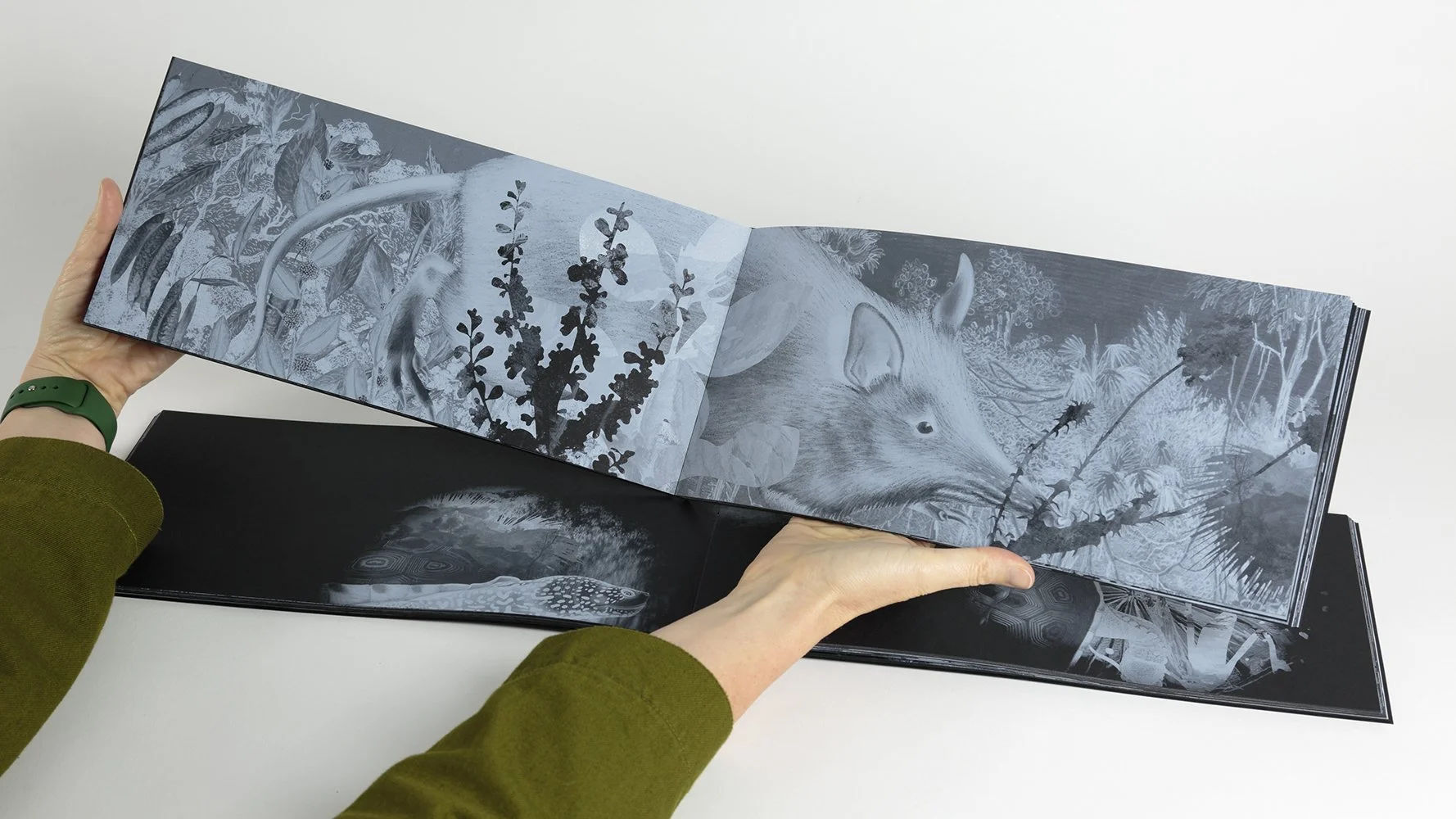
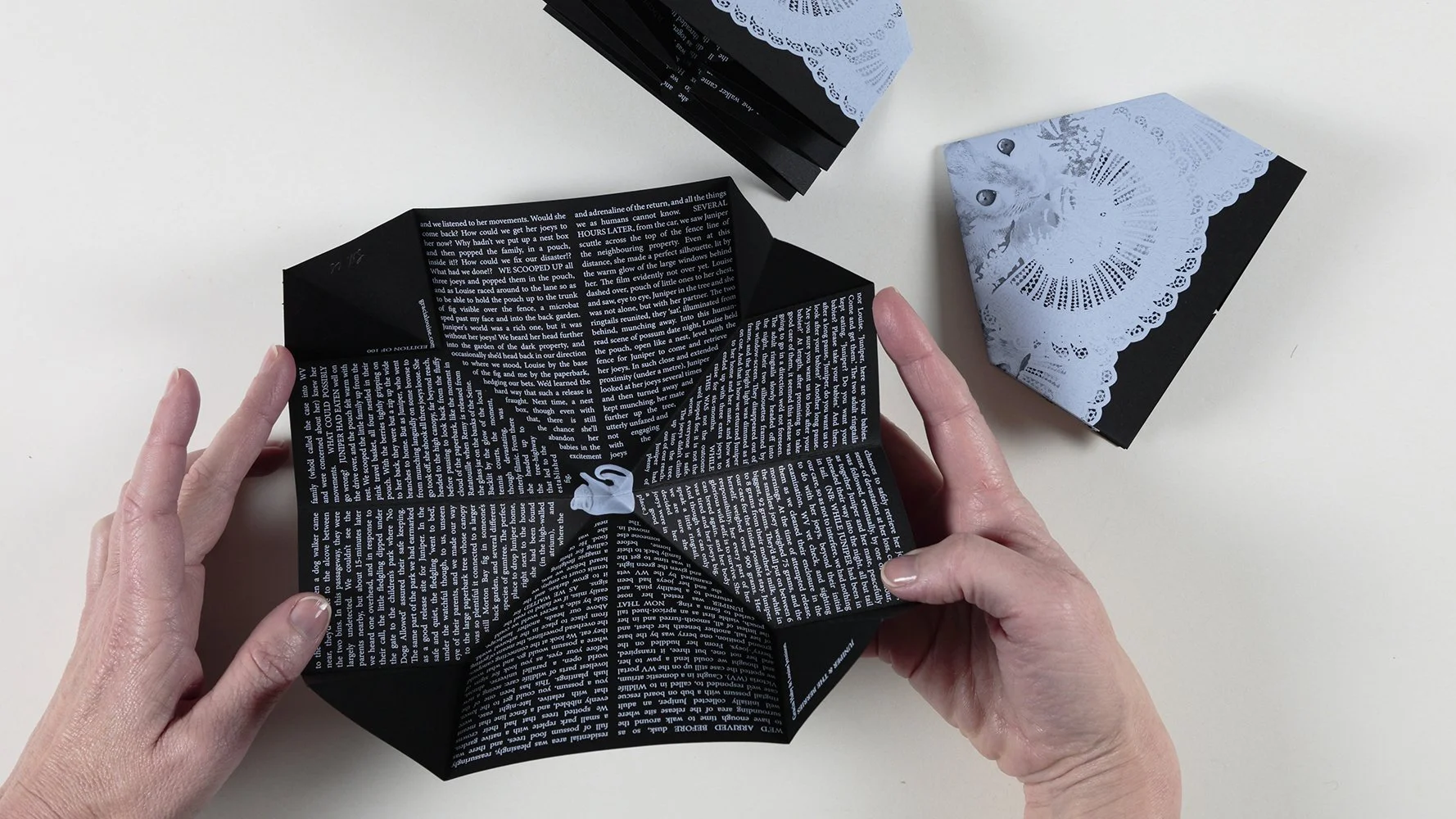
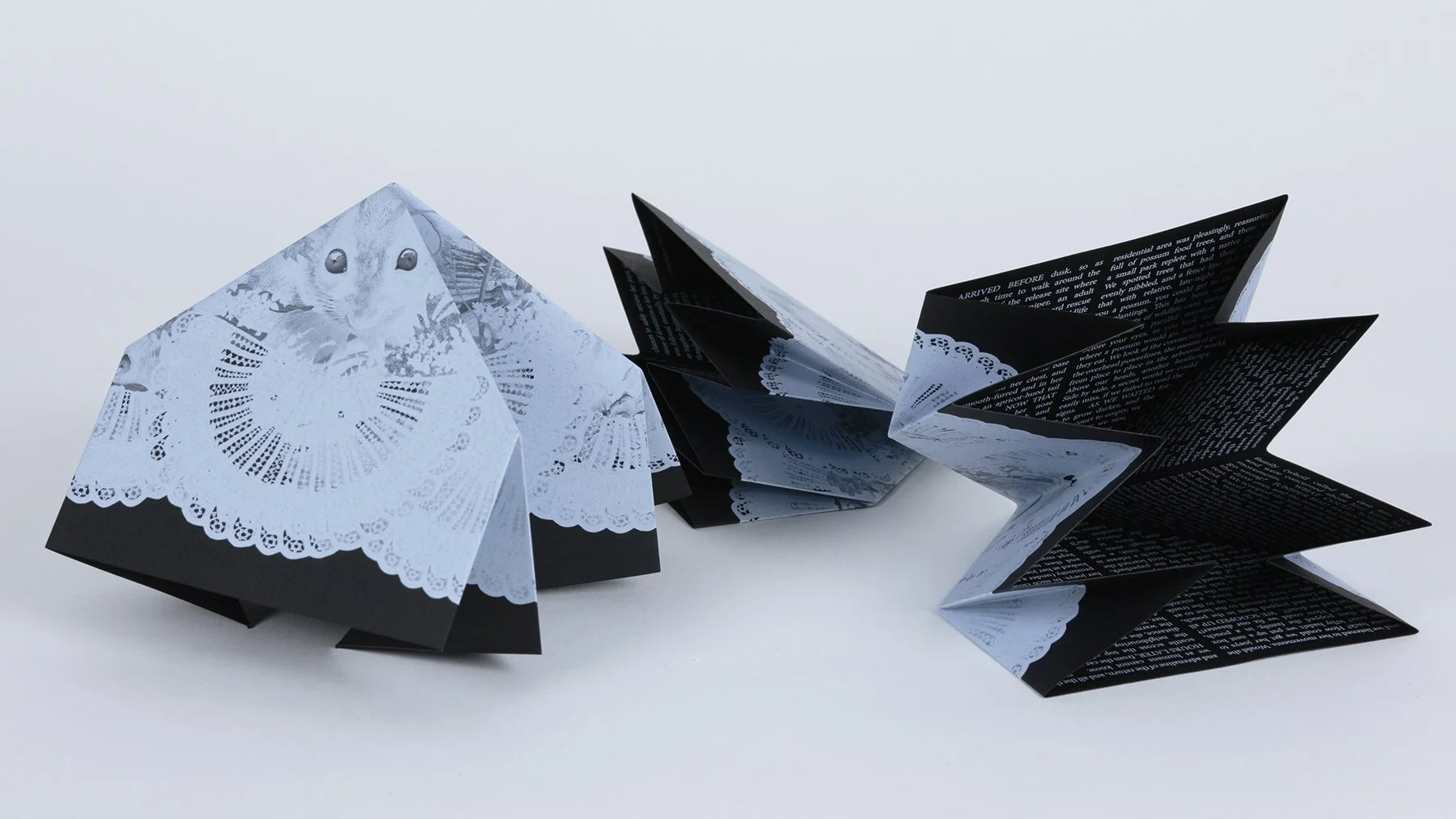
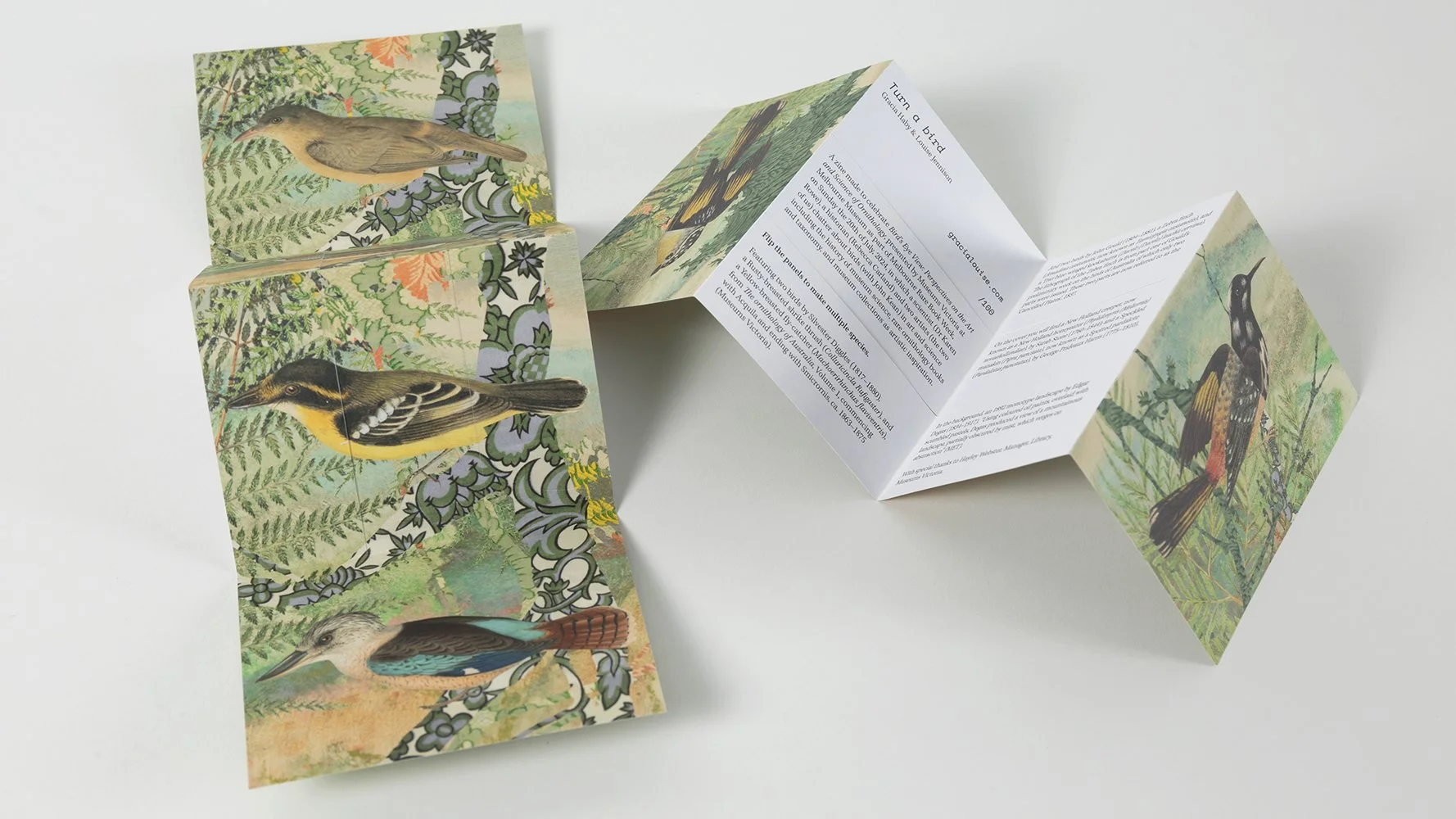
Our 26-page artists’ book, Bracketed by light, created in 2022, is one such call to attention and action introduced as a love letter. A love letter, specifically, to Remy and Pip, two orphaned Grey-headed flying fox pups; Rosetta, an adult Little forest bat, so micro to the mega previous, but just as clever and awe-inspiring, a flutter of agility; and Ruby, Clover, and Atlas, a brightness of Common, in name only, ringtail joeys. A love letter, more broadly, to those who require foraging resources and roosting sites; to the ingenious ecological kindness of the pollinators and seed dispersers; the echolocators catching insects on the wing; and the leaf-consuming fuel-reducers, the pepper-shakers. A love letter, wider still, to readers. To kinship, on the page. To thoughtful, meaningful interactions with and on behalf of wildlife and, in turn, habitat. Bracketed by light and 2024’s Bilateral Symmetry are examples of our labour-intensive, hand-bound artists’ books. Both are editions of 100, with Bilateral Symmetry featuring hand-stitching and pop-up elements. Even when using digital and commercial printing processes, we bring things back to the hand-made, in our celebration of treehoppers who, by “rapidly contract[ing] muscles in their abdomen[s],”[vii] send vibrational messages to one another through the stems of plants. We seek to echo the infinite variations and intricate relations in nature.
Wonder is our greatest antidote to self-destruction, and a pre-emptive activism against environmental destruction[viii], as Rachel Carson neatly surmised. “Those who contemplate the beauty of the earth find reserves of strength that will endure as long as life lasts.”[ix] This advice was written specifically for children, and it rings true for all, as Carson, in her challenge to posterity, wonders “if we have been looking through the wrong end of the telescope. We have looked first at man with his vanities and greed and his problems of a day or a year; and then only, and from this biased point of view, we have looked outward at the earth he has inhabited so briefly and at the universe in which our earth is so minute a part. Yet these are the great realities, and against them we see our human problems in a different perspective. Perhaps if we reversed the telescope and looked at man down these long vistas, we should find less time and inclination to plan for our own destruction.”[x]
There is much to be furious about, looking at any of the many, many injustices in the world, but you, we all, we are not powerless. Do not be lured into thinking that you are: “it is possible to be a force for change”[xi]. As Sabrina Imbler, on the extinguishing of the ancestral songs of Hawaiian crickets, describes, “the ways in which we alter the world—like shifting species on an island already transformed by colonialism—make it confusing to know what we should mourn. A species can exist in many permutations, no one more moral or deserving of life than any other. Now, instead of grieving the crickets’ past, I think about their future.”[xii]. Because, from our standing, indifference is a privilege. Despair is a luxury[xiii]. And hope is an action.


❧
In working with animals, we have learned patience. We approach feeding and caring for the possums on their terms, but, more importantly, in possum time. This echoes Sumana Roy’s ‘Tree time’, as she dispenses with her watch and removes the clocks from her walls: “One can’t tinker with the timing of a yawn, one cannot play with tree time”[xiv]. Abandoning “the panting pace” of news and “capsules of heightened and condensed time”, Roy tuned in to tree time, and began planting saplings to mark beginnings.
What we learn in the natural world, in nature, is how to live. And we are reminded that we are not separate from nature — even in the city, especially in the city — but a part of nature. Our artwork has often, and increasingly so, featured animals and is a space in which we can comment on how nature is not something separate, but a part of the whole. Not unlike our home-based studio and wildlife shelter interconnectedness, everything is gloriously entangled. And it is from this standing that we felt it was not enough for us to make work about wildlife without actually also doing something even more hands-on for wildlife. (That said, your version of this, will be something else, particular to you, for the choir is made of many voices, and stepping up requires many different skills, roles, and people; it is about finding what you, and those around you, are interested in and can do. And it is about commitment, long-term, oft unglamorous commitment.) In doing something more hands-on, our understanding has deepened and our awareness of the interrelatedness of all things has grown. This is, in a sense, a gift we receive, and it forms our own sense of sanctuary. It is also something we thought and knew we could do. First as foster careers for Bev Brown and Paul Smith of Bat Rescue Bayside, and now as our own shelter, and as Wildlife Victoria volunteers, looking after animals, from our home, round the clock; to us, it just fits. Like many things, rescues or wildlife care, to echo our earlier remarks, it is about something bigger than the self.
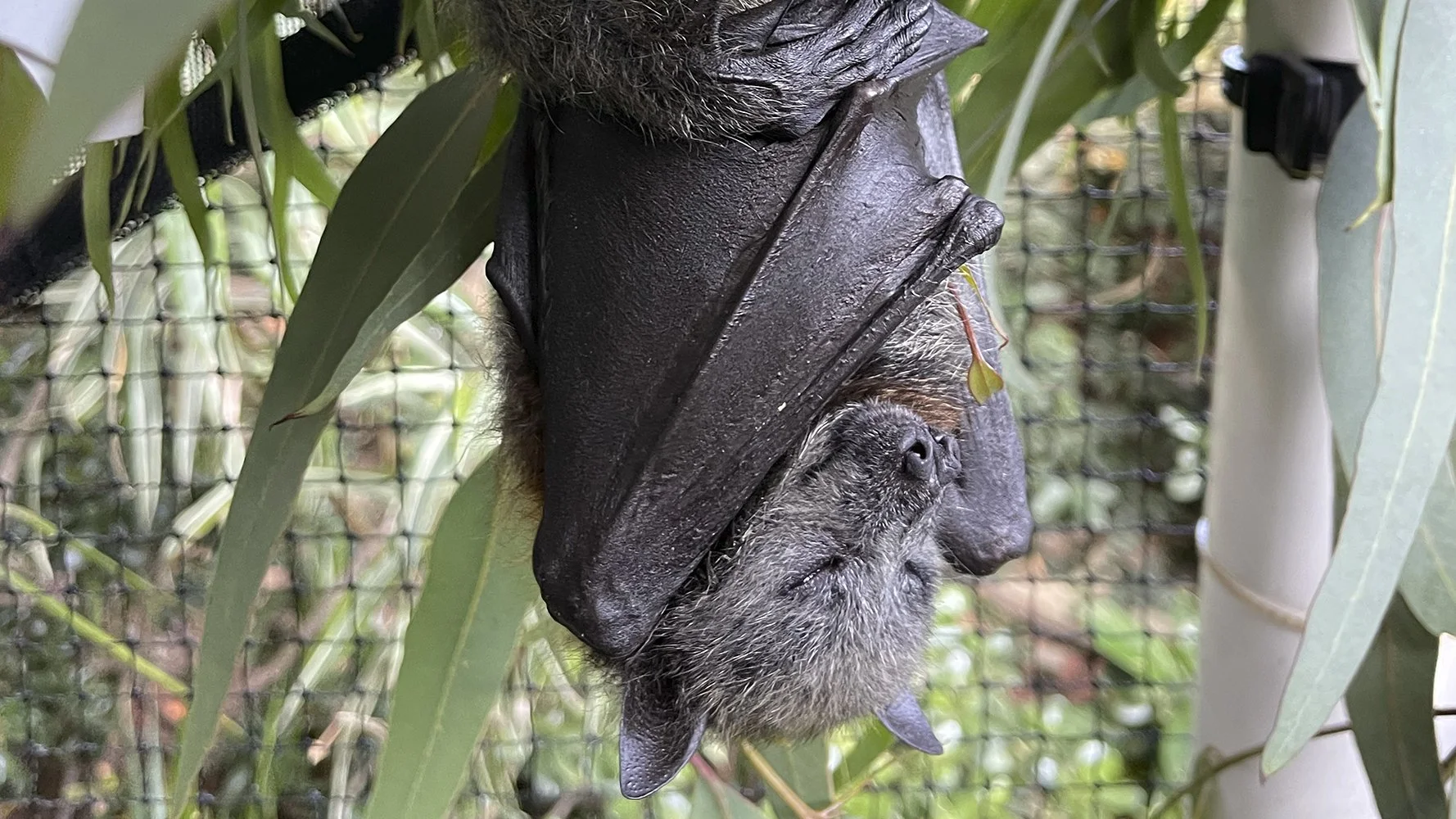
For instance, Grey-head flying foxes (Pteropus poliocephalus) can restore corridors of forest growth, if we let them do their thing. We cannot thrive unless they do, and how lucky are we to be connected to such an intelligent, social, cheeky, ancient, migratory, and spectacular species. How lucky we are to have these wise souls flying overhead each night, undertaking with in-flight grace and crash-landing ease, the art of pollination and seed-dispersal. From the Yarra Bend colony by the Birrarung, near to where we live, they thread out into the night sky, with the older pups left in designated nursery or crèche trees, awaiting their Mums’ return. To have possums leaving leaf-litter rich pellets in our gardens. To us, this chimes with Henry David Thoreau’s Walking meditation on wildness, and the sanctuary he found in the “raw material of the world”. To Thoreau, “hope and the future for me are not in lawns and cultivated fields, not in towns and cities, but in the impervious and quaking swamps”[xv]. And where he based elsewhere, we venture, add to the vision of swamps, a sighting of the only flying mammal.
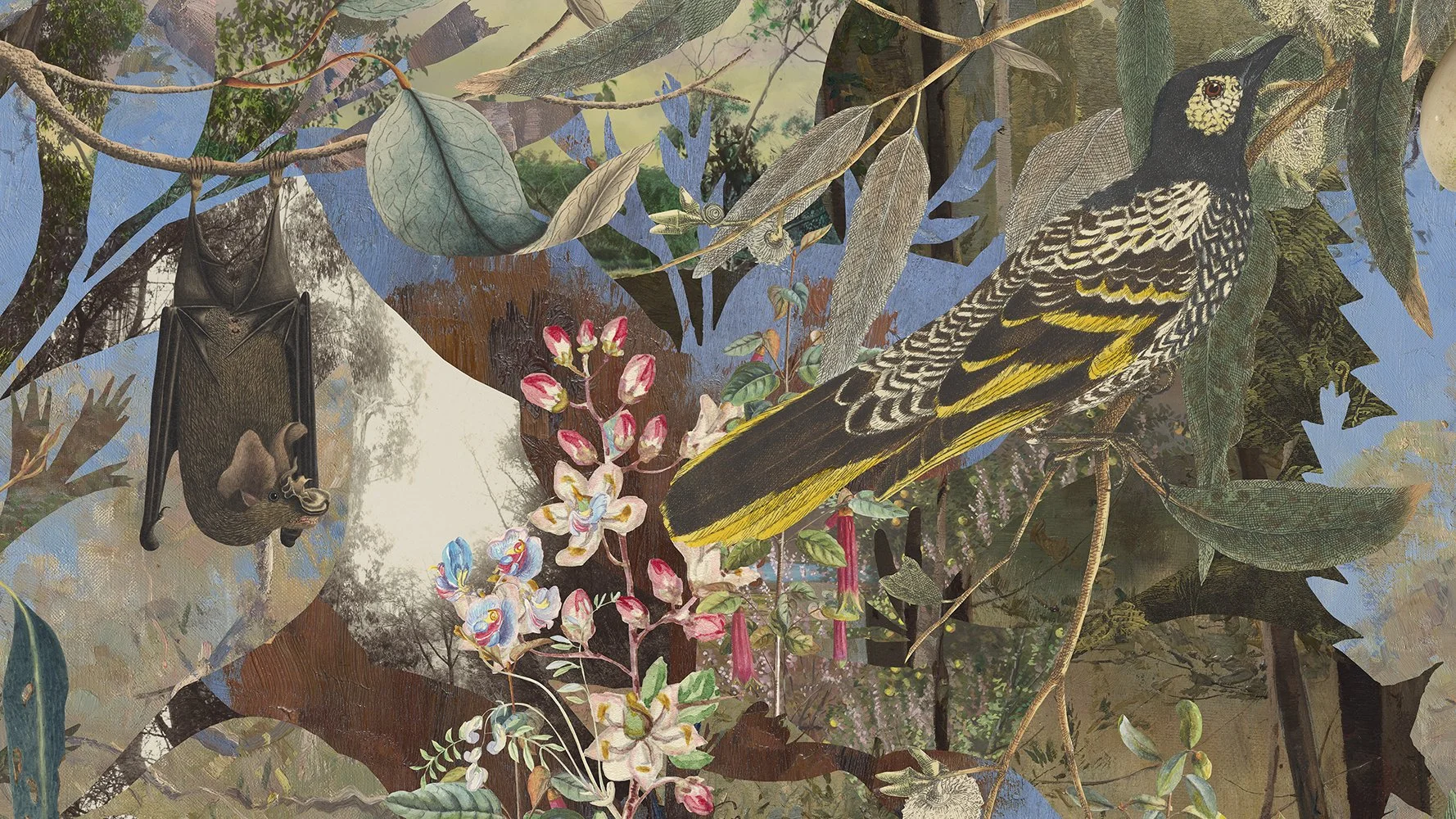
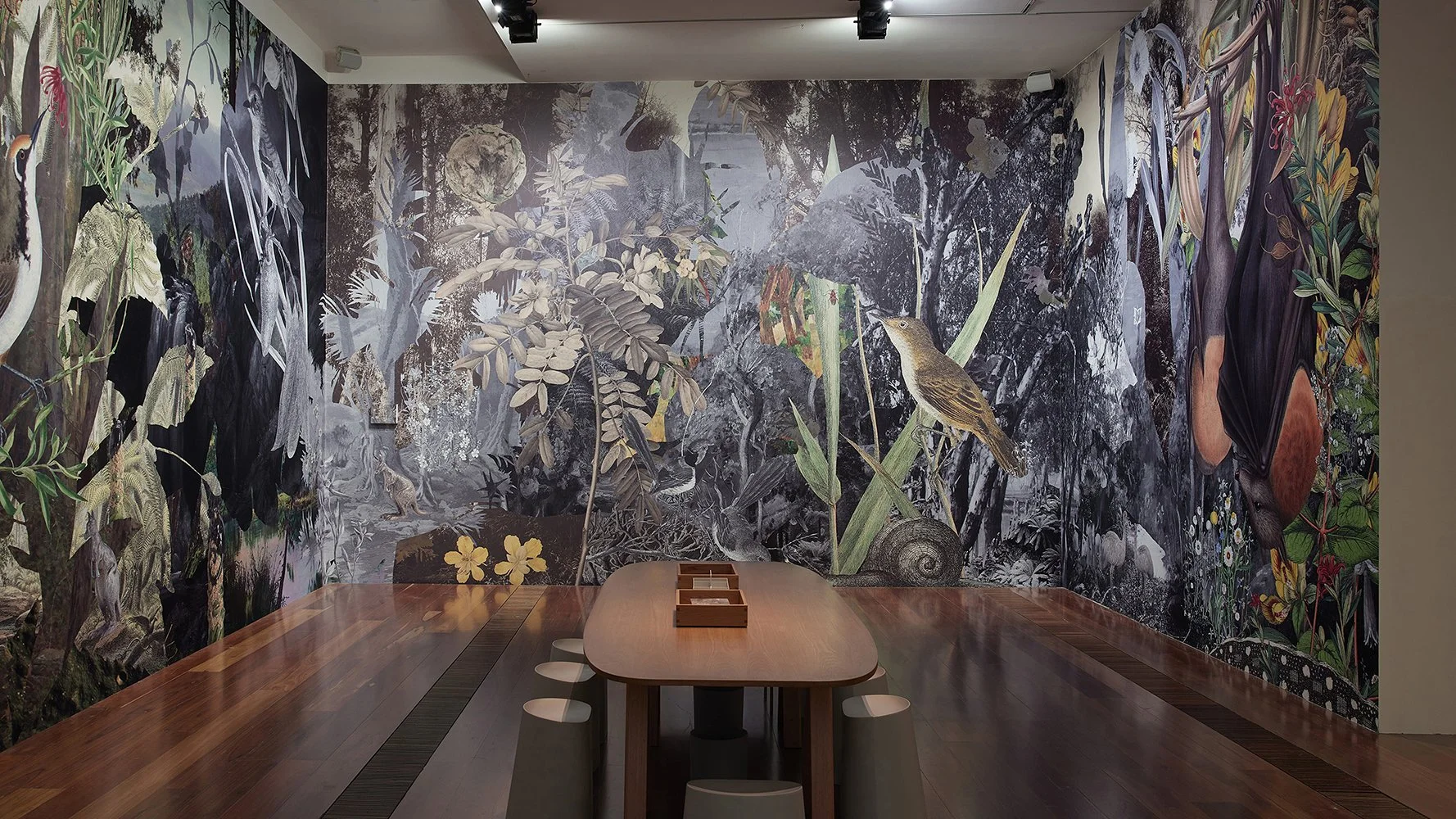
To raise awareness for the Grey-headed flying fox, for The remaking of things, our National Gallery of Victoria (NGV) Melbourne Now 2023 commission, we made a green pocket of restored eucalyptus forest habitat especially for the colony. Collaged from 100 pieces in the collection of the NGV, we created a 35-metre-long by 6-metre-high collage which was illuminated so that the scene transitioned from green mornings to nocturnal blues to represent 24-hours compressed into 24-minutes. The sound component is collaged from various Grey-headed flying fox colonies, and features Mum and pup contact calls, and the bonk-bonk of frogs. By making our collage about restored habitat, we were focusing on what we need to move ahead: grow habitat, protect biodiversity, ensure we have healthy soil to sustain “healthy crops, healthy animals, [and] healthy people”[xvi], reciprocate with nature.
Just as in Specimen 1963 you could see Eleazar Albin’s A natural history of English insects, from 1720, and Jan Swammerdam’s The book of nature, or, The history of insects : reduced to distinct classes, confirmed by particular instances, from 1758, in this work you can see Grace Cossington Smith’s Bottlebrushes (1935) and several photographs by Nicholas Caire featuring the Birrarung. We have used a photograph of a lunar crater near the Sea of Tranquillity from 1969 to suggest a wombat’s hollow, and added in the delicate details from Fanny Anne Charsley’s The wildflowers around Melbourne 1867 series. We have incorporated elements of Tom Roberts’s The artists camp, oil on canvas, from 1886, which you will also have seen in the background of Restoring Corridors and A fleeting sense of, where a flame becomes a parrot’s wing.
As with all our work, to date, we list the majority, if not all, of the sources. That these are attributed to the artists and makers is important to us, and it adds to the tapestry. We selected pieces which were either out of copyright, or we had permission to use, such as from the Estate of Grace Cossington Smith. And we selected pieces that large-format digital files already existed of, and pieces, like works on paper not currently on display, which could be rephotographed with a view to growing ten-times their original size on the gallery wall. Once more it was a collaborative process of working with the NGV, selecting pieces that would help us create a forest thrumming with life.
❧
Beyond the present, ours might be an “era of unprecedented man-made geological changes,”[xvii] seemingly on the edge of ruin”. To borrow, now, from Charles Darwin in his follow-up to “survival of the fittest” theory that moves beyond the “selfish gene”, to be “at home in the universe” requires us to transcend ourselves. And we all “have a voice in the shaping of the message — but that this message needs a great deal more nurturing and understanding . . . Much more importantly — standing with the best of minds and hearts over the ages—we are what we refuse to adapt to.”[xviii] To hold a mirror up, to hold the world accountable, to bear witness, or rather, as Joseph Brodsky wrote: to answer “not the question ‘how to live’ but ‘for the sake of what’ to live.” Humility might just be the remedy to our ecological crisis, as Christine Webb, author of The Arrogant Ape: The Myth of Human Exceptionalism and Why It Matters, believes: “When you measure the world with a ruler made for humans other species will inevitably look inferior.”[xix]
To kinship and community. To the power of words in the face of human exceptionalism. “To unthinking exploitation”[xx], as Robin Wall Kimmerer describes, through decomposing the use of the word ‘it’ to describe a butterfly or a bird. Grammar, the grammar of animacy, and art, can change how we relate to the natural world as we remember and reawaken. “Birds, bugs, and berries are spoken of with the same respectful grammar as humans are, as if we were all members of the same family. Because we are. There is no it for nature. Living beings are referred to as subjects, never as objects, and personhood is extended to all who breathe and some who don’t. I greet the silent boulder people with the same respect as I do the talkative chickadees.” ‘It’ takes possession of rights and is suggestive of a living world existing for human use, human extraction. “If it’s just stuff, we can treat it any way that that we want. But if it’s family, if it’s beings, if they’re other persons we have ecological compassion for them… Speaking with the grammar of animacy brings us all into this circle of moral consideration. Whereas when we say “it,” we set those beings, those “things,” as they say, outside of our circle of moral responsibility.”[xxi]
All of these ideas underpin our thoughts when making our work. One of the reasons we make zines is that they are another way to extend our audience, our message, to create a wider ripple. It is outward, this distribution of zines, like Juniper & the Berries (2025), a zine printed, as you saw earlier in Bracketed by light, with six layers of white ink on black paper.
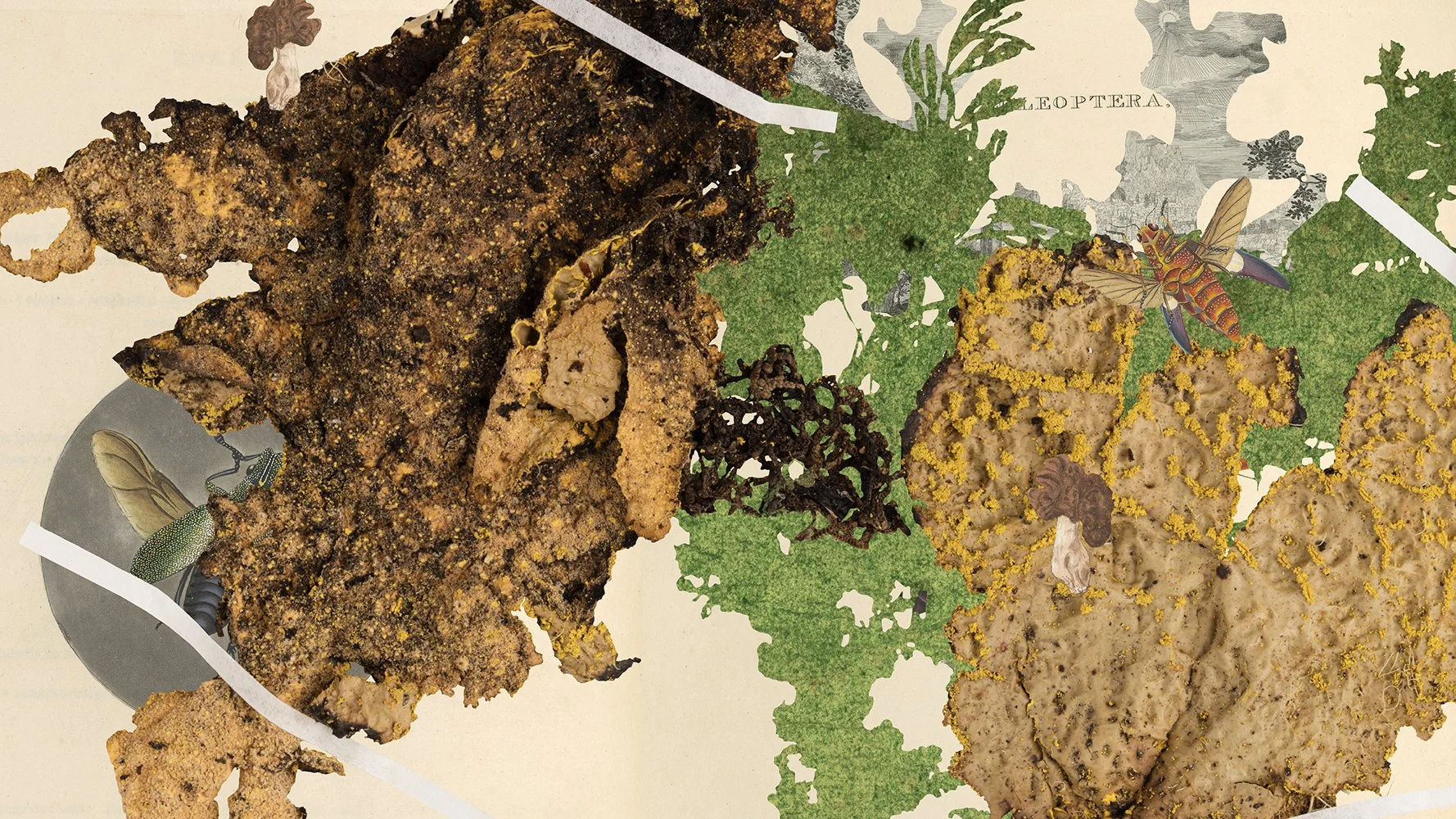
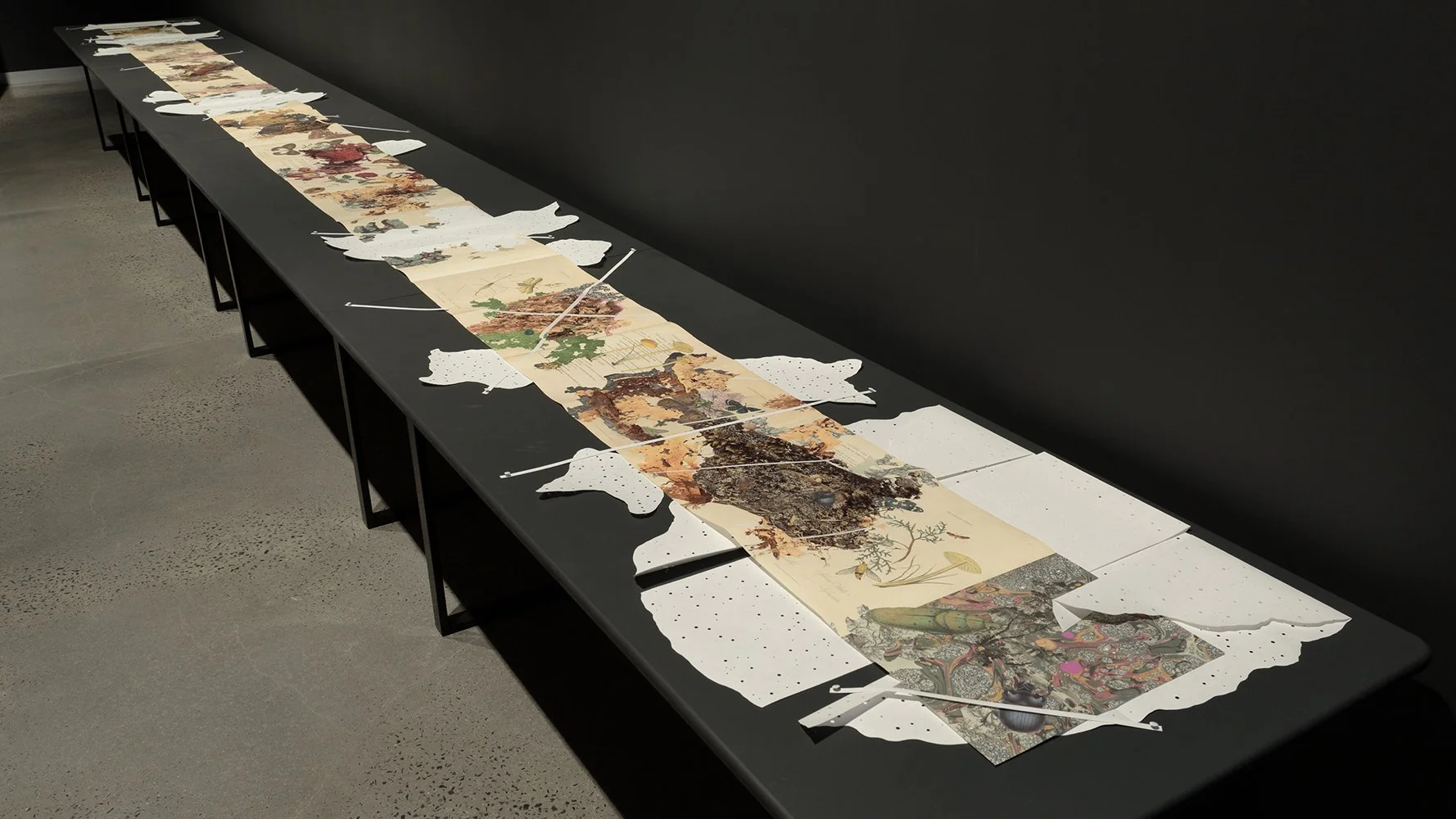
From Can we dream it? (2026), a unique state artists’ book, 9.6 metres in length (currently on display as part of the exhibition, curated by Dr Felicity Spear, Entanglements with Fungi: Life, Death and Renewal, at WAMA), we tried to imagine what an edition of Donovan’s An epitome of the natural history of the insects of China (1798) might look if it were buried beneath the earth. We thought about how fungi make worlds as well as how hand-coloured glossy highlights make Field crickets and Lantern bugs sing on the page. Whether drawn by the history of the source material or its re-spun narrative, the foundation remains: we are all the solutions. Though vested interests often ask us to look away, through continued outer awareness, we can all learn from the more-than-human, and thereby shape the unwritten, undetermined path. Be like a dragonfly who “carries with [him or her] the memory of millions of years — a legacy we can’t hope to match”[xxii]. Be like “the “immortal” jellyfish-like hydrozoan (Turrotopsis nutricul) [who] can reverse their life cycle and be reborn, apparently indefinitely; the salamander [who] can generate new limbs, the crayfish, new claws, and the conch, new eyes.”[xxiii]
Be all a little bit wild.

[i] George Prochnik, ‘Silence’, 30th May, 2018, Emergence Magazine, https://emergencemagazine.org/essay/silence, accessed 1st July, 2026.
[ii] Rachel Keir-Smith, ‘Slowly and Deliberately’, Slow Read exhibition catalogue, Town Hall Gallery, 2026.
[iii] “Different from habitat loss and habitat degradation, habitat fragmentation occurs when a species’ habitat gets broken into pieces that are no longer connected to each other. …Many common causes of habitat fragmentation are linked to human activity. Building roads, railways, pipelines, farms, housing, cities, and other infrastructure can divide wild areas into pieces. Not only do human settlements physically block animals from reaching parts of their habitat, but they also can use up resources, effectively decreasing the suitable habitat available to these animals. Other human activities that can fragment wildlife habitats include oil and gas exploration, commercial development, and diverting water through technology like dams. For example, freshwater fish face severe limitations when dams are built in rivers. They can completely block their migration routes and cut them off from areas where they once were plentiful.” ‘How Habitat Fragmentation Affects Animals’, International Fund for Animal Welfare (IFAW), 1st April, 2024, https://www.ifaw.org/au/journal/habitat-fragmentation-affects-animals, accessed 2nd April, 2024.
[iv] Today, over 2,000 species of plant, animal and ecological communities, including over 590 native animals, are officially listed as threatened under Australia’s EPBC Act 1999, World Wide Fund for Nature (WFF Australia), https://wwf.org.au/what-we-do/species/national-threatened-species-day, accessed 1st July, 2026.
[v] Andrew Henry Weber, ‘Wildness and Wonder: on saving the planet’, 17th April, 2018, Center for Humans & Nature, https://humansandnature.org/wildness-and-wonder-on-saving-the-planet/, accessed 1st July, 2026.
[vi] Katherine Rundell quoted by Maria Golia in relation to her book The Golden Mole, ‘Joy and destruction: Lovingly crafted vignettes of endangered animals, Times Literary Supplement, 21st October, 2022, https://www.the-tls.com/regular-features/in-brief/the-golden-mole-katherine-rundell-book-review-maria-golia, accessed 1st July, 2026.
[vii] Ed Yong, An Immense World: How Animal Senses Reveal the Hidden Realms Around Us (London: Penguin Random House, 2023), p. 193.
[viii] Saskia Beudel, ‘Science, wonder and new nature writing: Rachel Carson’, Routledge Handbook of Ecocriticism and Environmental Communication, 2019, Beudel, S. (2019). 'Science, wonder and new nature writing: Rachel Carson'. Routledge Handbook of Ecocriticism and Environmental Communication. https://doi.org/10.4324/9781315167343-23, accessed 2nd July, 2026.
[ix] Rachel Carson, quoted by Mark Wilson in relation to The Sense of Wonder, ‘Letter from Mark Wilson to Rachel Carson’, Environment & Society Portal, https://www.environmentandsociety.org/exhibitions/beyond-doom-and-gloom/letter-mark-wilson-rachel-carson, accessed 2nd July, 2026.
[x] Rachel Carson, quoted by Maria Popova, ‘The Poetry of Science and Wonder as an Antidote to Self-Destruction: Rachel Carson’s Magnificent 1952 National Book Award Acceptance Speech’, https://www.themarginalian.org/2022/11/30/rachel-carson-national-book-award-speech/, accessed 2nd July, 2026.
[xi] ‘Katherine Rundell: ‘Looked at squarely, humankind is breathtaking’, Kitty Empire, The Observer, 18th September, 2025, https://observer.co.uk/culture/books/article/katherine-rundell-looked-at-squarely-humankind-is-breathtaking, accessed 1st July, 2026.
[xii] Sabrina Imbler, ‘Key Changes: The cricket’s song is a story of survival — and so is mine’, Spring 2025, Queer Planet: A Celebration of Diversity, Orion Magazine, https://orionmagazine.org/article/key-changes/, accessed 1st July, 2026.
[xiii] Robert Macfarlane and Terry Tempest Williams in conversation, ‘Dreaming with Water: On not looking away, Orion Magazine, 16th July, 2025, https://orionmagazine.org/article/dreaming-with-water/, accessed 1st July, 2026
[xiv] Sumana Roy, ‘Tree Time’ excerpt from How I Became a Tree, The Paris Review, 30th August, 2021, https://www.theparisreview.org/blog/2021/08/30/tree-time/, accessed 1st July, 2026.
[xv] Henry David Thoreau, Walking, The Walden Woods Project, https://www.walden.org/wp-content/uploads/2016/03/Walking.pdf, accessed 1st July, 2026.
[xvi] Tim Flannery: “We must remember that the soil is the foundation of all life. Without healthy soil, we cannot sustain healthy crops, healthy animals, or healthy people”. ‘Healthy soil: what is it and why is it important?', Charles Sturt University, https://insight.study.csu.edu.au/healthy-soil/, accessed 2nd July, 2026.
[xvii] Anna Badkhen, ‘To See Beyond: A Hoping in Three Pictures’, Emergence Magazine, 27th June, 2022, https://emergencemagazine.org/essay/to-see-beyond/, accessed 2nd July, 2026.
[xviii] David Loye, Darwin’s Lost Theory (Carmel, CA: Benjamin Franklin Press), pp. 341–343.
[xix] Christine Webb quoted by Kermit Pattison, ‘Human exceptionalism is at the root of the ecological crisis’, The Harvard Gazette, 8th October, 2025, https://news.harvard.edu/gazette/story/2025/10/human-exceptionalism-is-at-the-root-of-the-ecological-crisis/, accessed 1st July, 2026.
[xx] Robin Wall Kimmerer, ‘Speaking of Nature: Finding language that affirms our kinship with the natural world’, Orion Magazine, 12th June, 2017, https://orionmagazine.org/article/speaking-of-nature/, accessed 1st July, 2026
[xxi] Robin Wall Kimmerer and Helen Whybrow, ‘Robin Wall Kimmerer on Language Animacy: A Conversation with Orion’, Orion Magazine, 17th July, 2017, https://orionmagazine.org/article/robin-wall-kimmerer-language-animacy/, accessed 1st July, 2026.
[xxii] Lev Parikian, ‘The Dragonfly’, Taking Flight: How animals learned to fly and transformed life on Earth (London: Elliott and Thompson Limited, 2023) , p. 37
[xxiii] Andrew Henry Weber, ‘Wildness and Wonder: on saving the planet’, Center for Humans & Nature, https://humansandnature.org/wildness-and-wonder-on-saving-the-planet/, accessed 1st July, 2026.
Image credit: Gracia Haby & Louise Jennison, Bilateral Symmetery, 2024, artists’ book, photographed by Tim Gresham
Throughout the above, the fleuron (❧), which consists of a leaf or flowerlike glyph, has been used as a dinkus (accessed via ‘Ode to the Dinkus’, The Paris Review).
