Re-spun and altogether aerial
Duck Pond
Thursday 15th January, 2026
Princess Theatre, Melbourne
Director: Yaron Lifschitz
Composer and Sound Designer: Jethro Woodward
Costume Designer: Libby McDonnell
Lighting Designer: Alexander Berlage
Associate Director: Marty Evans
Dramaturg and Associate Choreographer: Rani Luther
Voice Over Artist: Elise Greig
Cast
Prince: Adam Strom
Ugly Duckling and White Swan: Sophie Seccombe
Black Swan: Maya Davies
Fairy Swan Mother: Asha Colless
Tristan St John
Jordan Twartz
Harley Timmermans
Darby Sullivan
Anais Stewart
Clara Scudder-Davis
Rose Symons
Lucy Hunterland
Gerramy Marsden
Anisa Monsour
Feathers Flying, my response to Yaron Lifschitz and Circa’s Duck Pond, drawn up especially for Fjord Review.
In a world where Tchaikovsky meets Hans Christian Andersen, circus meets dance, dizzying heights meet plunged beneath the water, classic meets reinvention, and ducks transform and hook-up with swans, of course a different outcome emerges. And, of course, it is fun as it does so, grafting elements of classical ballet’s Swan Lake and the fairy tale of The Ugly Duckling to this new performance, Duck Pond. Created by Yaron Lifschitz and the Circa ensemble, the 14-strong cast visually appear to derive pleasure from the tail-feathered hijinks such a melting pot of waterfowl references yield. On opening night, by the make-believe pond on the stage of the Princess Theatre, the family Anatidae (comprised of ducks, swans, and geese) quack-quack, peep-peep, and soar through the air.

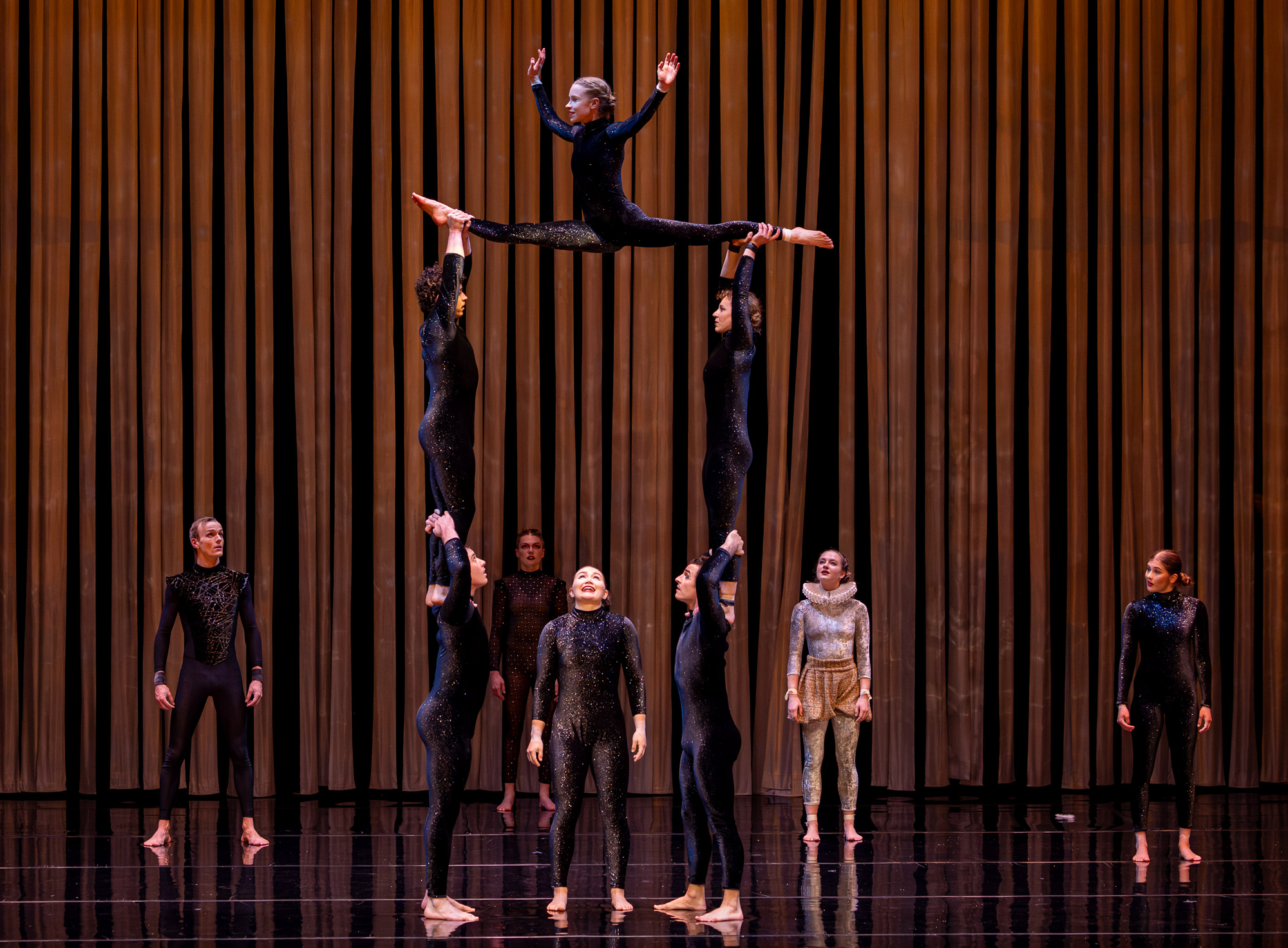
Circa ensemble in Duck Pond, photographed by Daniel Boud
As per the fairy tale, the ugly duckling transpires to be neither ugly nor duckling but a beautiful swan. A beautiful white swan, who, having been, as Anderson described, pecked by ducks and beaten by hens, finds an undreamt-of happiness when they unlock their true form. When Sophie Seccombe sheds her Ugly Duckling costume and becomes the White Swan she has always been, the assuming of one’s true form feels like the heart of Duck Pond. Re-spun and altogether aerial, in this tale of personal discovery, growth, and identity, the reason for the White Swan not ending up with Adam Strom’s befuddled Prince differs. In a place not so ‘of pretend’ nor ‘far, far away’ after all, transitions are joyful in every sense, be they characters destined and entwined, or acrobatic feats of intensity and prowess.
Runaway, join the circus. Don a pair of webbed yellow feet to enable you to pad about. Sport a yellow visor for a makeshift bill. If one part of Duck Pond is an affirmation of following your heart and being true to yourself, another part invites you to play. And so a mop can become monkey bars in the playground, and a crumpled pile of ducks in a row can become a hillside for Seccombe, still as an Ugly Duckling, to scale. With a broom in hand, in the midst of sweeping up feathers after a pillow fight which went a little too hard, she ascends, playfully finding her footing, step by step. Transformations are at home in the circus.
From partner lifts, throws, and tosses, from my vantage in the stalls, the Circa acrobats fly as if winged. The circus transposed to theatre setting scales even loftier heights from this perspective, looking upwards to the stage. Overhead, they truly tower, and as one acrobat stands upon the shoulders of another with familiar ease, for a moment I am convinced that this is not in fact how we should always move about when in pairs. But why leave it at two, when a third person can scale the formation and perch aloft. Why leave it at three, when a fourth person can scale the formation and make for an impossibly high human structure. As Rose Symons pauses, the fourth person in said stack, before making her feet-first plunge into the scene of Palace merriments, such building of spectacle not only amuses, but guides the story, in the first two acts (Act I: The Palace and Act Two: The Lake). From Maya Davies’s Black Swan aerial pole (also known as a Chinese mast) awe-inspiring vertiginous solo to four performers suspended from an aerial hoop (also known as a lyra), moving in perfect, balanced unison, as if taking turns to recline upon a full moon, so many circus feats astound for their mixture of grace and strength, poise and speed. Dare to dream, they coax.
Libby McDonnell’s minimal and sparkled costume design affords the performers the freedom, security, and flexibility to balance and twist in their succession of aerial contortions and hand balances. The Prince is denoted by a golden crown, the Ugly Duckling by bloomers suggestive of down soon to give way to feather, and the Fairy Swan Mother, assumed by Asha Colless, sprouting wings of both black and white, unified by a red seam, and a sense of the ability to take you under her wing.
An ornamental lake is suggested by the lighting of Alexander Berlage, and swathes of blue fabric, suspended from high above, from which the Prince performs figures and falls. With the stage bare, to leave the performers space to beguile, the setting is described through the changing palette, and the composition by Jethro Woodward, with notes of Tchaikovsky’s unmistakable score as if fractured and submerged. Drifting across the swell, all of these elements meld, static backbends and dynamic drops from which surely coined the collective longing of running away to join the circus.
Tristan St John, Jordan Twartz, Harley Timmermans, Darby Sullivan, Anais Stewart, Clara Scudder-Davis, Lucy Hunterland, and Gerramy Marsden round out the circus like a Cyr wheel. Whether performing aerial splits or in a human tower, every suspended pose in turn poses the question: “will you hold me? Will I hold you?”[i] in the thrill of danger made visible.
[i] Yaron Lifschitz, Director’s Note, Duck Pond Melbourne programme 2026, p. 9.
Subscribe to and support Fjord Review.
Fjord Review is a world-class review of ballet and dance. Edited by Penelope Ford, Fjord publishes original dance criticism, interviews, features, essays, photography, and hosts the podcast, Talking Pointes, a bronze medalist for the Best Arts & Culture podcast by the Australian Podcast awards in 2022. Our contributors, based in five continents, are dance scholars, critics, artists, and emerging voices united by a passion and gift for illuminating dance. In 2018, Fjord was nominated for a Canadian National Magazine Award for excellence in digital publishing, and since 2019 we have published a biannual print magazine.
Fjord Review reaches over a hundred thousand readers each year, and delivers a weekly dance digest newsletter to thousands of dance enthusiasts each week. Whether you are a self-confessed balletomane or new to dance, we hope you find a companion in Fjord Review.
Image credit: Duck Pond by Yaron Lifschitz and the Circa ensemble, by Daniel Boud
