Whether in the rainforest or the gallery setting
From Dancehouse to the Potter Museum of Art
never are
Emma Riches
Saturday 21st February, 2026
Upstairs Studio
Dancehouse, Melbourne
Choreographer / Performer: Emma Riches
Collaborator & Body Double: Emma Harrison
Sound Designer: Rachel Lewindon
Production Designer: Sam Read
Costume Designer: Sandra Riches
Mentor: Martin del Amo
Outside Eye: Rhiannon Newton
Amorphophallus blooming
and
Victoria amazonica blooming
Ingela Ihrman
Friday 20th February and Saturday 21st February, 2026
Ground floor
Potter Museum of Art, Melbourne
Presented as part of The giant flower festival on the opening weekend of the exhibition, A velvet ant, a flower and a bird, curated by Professor Dr Chus Martínez
Notes from the Underground, my response to Emma Riches’s never are, and Amorphophallus blooming and Victoria amazonica blooming by Ingela Ihrman, drawn up especially for Fjord Review.
Beneath my feet, thousands upon thousands of tiny threads in the soil transmit messages and nutrients, actions and behaviours. Symbiotic mycorrhizal networks pulsate in a system of life I cannot see, but, more and more, have a growing sense of: a realm of fungi that supports and sustains near to all living systems. Out of sight, though this may be, beneath my feet, in the gallery at the Potter Museum of Art, and later at Dancehouse, the map of mycorrhizal networks bustles in a complexity that never sleeps, a thriving cosmopolis under the city and her cultural landmarks. Entering the darkened humidity of the Upstairs Studio space at Dancehouse, for Emma Riches’s closing night performance of her work never are, I might be physically further from the earth, but there is a strong sense of actually being beneath the surface, of being in the soil itself. Somehow, since making my way up the stairs, I’ve crossed a threshold and I am now in a fertile compost heap, and the sound, thanks to Rachel Lewindon, pings to affirm that this is so. Is this what it sounds like as nutrients are traded in symbiotic partnerships?
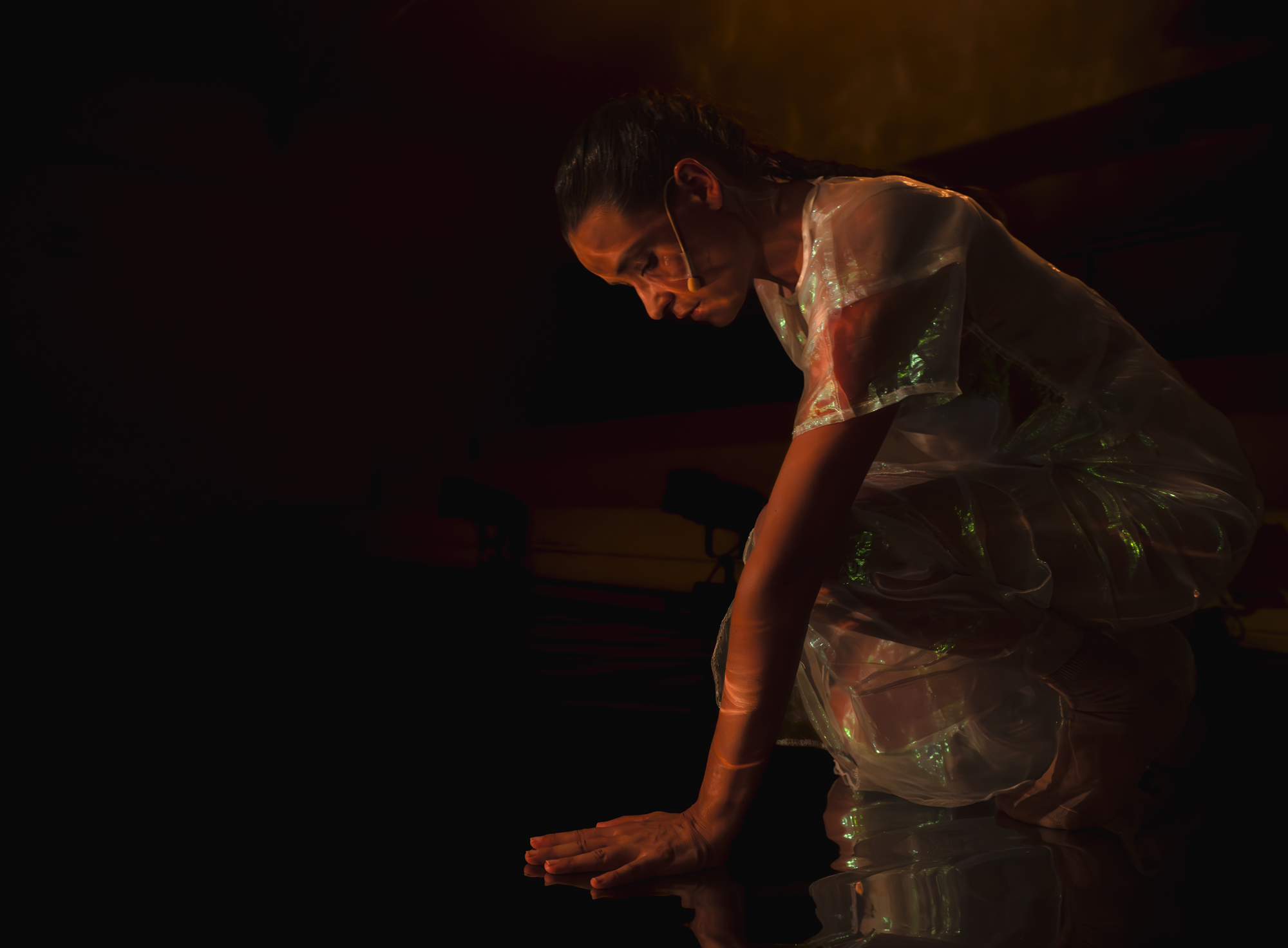
As Riches walks backwards in measured steps, mapping a large mirrored rectangular surface in the centre of the space, there is a sense that she is in fact a tendril transmitting real-time messages through the soil. As the audience takes their seats along two opposing sides of the rectangle, Riches continues to walk backwards, in considered meditation. Before she passes along one of the sides, flanked by seating, people who previously had their legs crossed, and a foot extended near to the performance area, alter their positions to give her space to continue her transmission. The collective gentle encroachment of the audience, one by one, we tuck our feet in, and Riches continues along her path. In a costume designed by Sandra Riches, the texture of an iridescent pearl, she glides past in socked feet, and it occurs to me that perhaps she is not walking backwards at all. If a performing body can become a manifestation of a mycorrhizal network, who is to say that Riches is walking backwards at all?
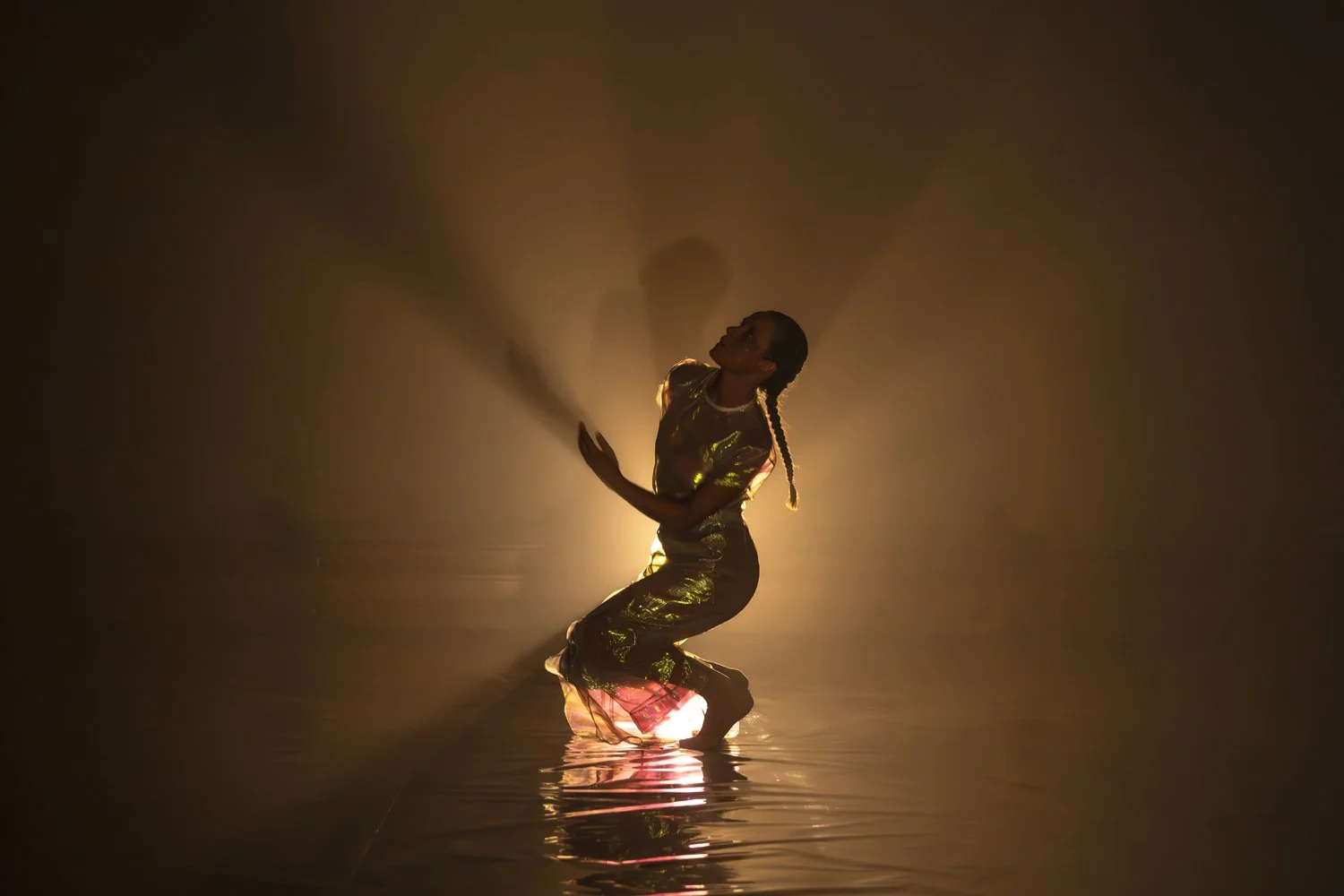
Emma Riches's never are, photographed by Gregory Lorenzutti
At the corner of the mirrored surface, Riches enters on the diagonal line, her form mirrored by the surface, just as the audience in the row of seats opposite are also something of a mirror, gleaned through the haze. An ambiguous mirroring that abstracts the familiar with its rippled pattern, Riches reflected twin wrinkles and grows her form. never are is hypnotic in the details that are layered slowly, step by step, in the process of becoming “a compost of itself [as] components break down, decay, and nourish[i]”. Movements are added to the sequence, from resting on all fours, before swooshing her shins, pressed together at the knees, out to the side. Riches rolls over and rests on her side, her head propped up with her arm making the shape of a triangle. She looks at the audience, and she repeats the sequence. She grows the sequence, adding to the lexicon she is drawing in shapes for the audience to decipher. Movements are “re-used, re-affirmed, and re-imagined.[ii]”
To this pattern, words enter the landscape. “You”, says Riches, and it echoes like the “re-used” movements throughout the space. “Are” joins the collage. Or was it the other way around, did “are” proceed “you”? Soon, to the patchwork of spoken words held in slow pauses, “Are you”, “even if”, “you”, and “think” are added.
A language of symbols is forming, and in a bid to understand, the words grow in importance, to me. They become the key to the sequence. Lying on her side, she takes away her hand from supporting her head, letting her arm extend along the floor, the sound of her arm connecting loudly with the floor is twinned with the word “are”. A three-letter word — “are” — for a three-letter body part — “arm”. The word “think” is connected to Riches as from a coiled forward position, not unlike Rodin’s The Thinker, she hovers her form off the ground, supported by her hands.
Further words are collaged with actions. “Might” is often shown as Riches lying on her back, her upper body propped up by her forearms, as she looks forward. “Be” is joined to her legs raised in the air as she wriggles them about and tries to lift her upper body in the process, as if a caterpillar jiggling. The word “there” is shown by an arm extended to the side, pointing in the direction somewhere ‘over there’. Of course, as soon as I feel I have the code, things change, and the same words, in a different order, take on other possible readings. Almost as if to say, ‘don’t get too caught up in metaphors.’ Words in the soil, broken down, definitions are tilled and presented open-ended.
Following the underground threads, around the corner, from such fertile soil, grows Ingela Ihrman’s Amorphophallus blooming and Victoria amazonica blooming. Two performances, conducted over two nights, presented as part of The giant flower festival on the opening weekend of the exhibition, A Velvet ant, a flower and a bird, curated by Professor Dr Chus Martínez, which invites me to look to the intelligence of the more-than-human. In two costumes made from packaging tape, Velcro, “glue, wheat flour, golf pegs, [and] plastic foam”[iii], Ihrman’s Giant water lily (Victoria amazonica blooming), and Giant corpse flower (Amorphophallus blooming), like Riches’s below the surface and in the soil exploration at Dancehouse, diminishes my personal scale and renders me awe-struck. Riches and Ihram, in different ways, make me question not only my scale, as I break down into the soil, but the ways in which we connect with one another. One through the layering of sound and movement sequences, and the other through the layering and careful reinvention of everyday items to make a hand-dyed sculpture which can be worn and animated, positing: how do you sense your environment? The living world is a network of communication, and we are all of us made up of microbes that live on and within us[iv].
The sensing body in Ihram’s Giant corpse flower teeters at the edge of the curved plinth. Ihram’s bare feet can be seen, hinting at concealment and “protective armour around a vulnerable interior”[v]. Notorious for its smell of rotting flesh (to attract insects for pollination at night), Ihram raises her concealed hand from within the dark crimson structure to mist the audience with a perfume created to mimic the actual smell of the Corpse flower. As the scent reaches the audience, many move away or pull their clothing up over their noses. The rare inflorescence of the Corpse flower is years in the making, whether in the rainforest or the gallery setting. It repels and attracts in equal measure, depending upon the individual, and for one reason or the other, I am the latter. The tall central spadix tips forward, like an elongated conical hat. It lands, spent.
From a place of smelling and listening, I wonder what the world is like from another perspective, but more than this, I am reminded of the importance of togetherness. Looking at how other living organisms process and solve problems, I would fail the intelligence test of the Giant corpse flower. Similarly, looking at the intricacy involved in the ability to adapt to a changing environment and how information is processed within compost, from the cycling of nutrients to the cycling ideas, I would also fail. And it is from recognising the skills and different other ways of being, in these instances, the more-than-human, that we learn, and this enriches us all.
Let the earthly cycle ever repeat.
[i] Emma Riches, never are artist’s statement, Dancehouse, https://www.dancehouse.com.au/whats-on/never-are, accessed 21st February, 2026.
[ii] Emma Riches, never are artist’s statement.
[iii] Ingela Ihrman, The Giant Water Lily Victoria amazonica blooming, 2012, list of materials, https://www.ingelaihrman.com/work/the-giant-water-lily-victoria-amazonica-blooms/, accessed 21st February, 2026.
[iv] Merlin Sheldrake in conversation with Jonathan Fields, ‘The Life-changing magic of fungi’, Good Life Project podcast, https://www.goodlifeproject.com/podcast/the-hidden-intelligence-of-fungi-how-mushrooms-mycelium-networks-impact-our-world, accessed 22nd February, 2026.
[v] Ingela Ihrman, Frutti di Mare 2023–2024 catalogue, https://www.ingelaihrman.com/v2/wp-content/uploads/2024/10/MK_IngelaIhrman_Digital_Karta_Eng.pdf, accessed 22nd February, 2026.
Subscribe to and support Fjord Review.
Fjord Review is a world-class review of ballet and dance. Edited by Penelope Ford, Fjord publishes original dance criticism, interviews, features, essays, photography, and hosts the podcast, Talking Pointes, a bronze medalist for the Best Arts & Culture podcast by the Australian Podcast awards in 2022. Our contributors, based in five continents, are dance scholars, critics, artists, and emerging voices united by a passion and gift for illuminating dance. In 2018, Fjord was nominated for a Canadian National Magazine Award for excellence in digital publishing, and since 2019 we have published a biannual print magazine.
Fjord Review reaches over a hundred thousand readers each year, and delivers a weekly dance digest newsletter to thousands of dance enthusiasts each week. Whether you are a self-confessed balletomane or new to dance, we hope you find a companion in Fjord Review.
Image credit: Emma Riches's never are, by Gregory Lorenzutti
