Falling softly, assuredly
R.A.I.N
Harrison Ritchie-Jones
Wednesday 16th September, 2026
Arts House, North Melbourne Town Hall
Choreographer: Harrison Ritchie-Jones
Dancers: Harrison Ritchie-Jones and Michaela Tancheff
Composers: Moses Carr and Nick Roder
Lighting Designer: Alex Nguyen
Costume Designer: Andrew Treloar
Production Manager: Shiv Geaney
Producer: Michaela Coventry – Sage Arts
This project has been assisted by Studio 24, Chunky Move and City of Melbourne through Arts House.
R.A.I.N Dance, my response to Harrison Ritchie-Jones’s R.A.I.N, drawn up especially for Fjord Review.
What form might radical compassion take? If you tease apart an acronym for a meditation practice for cultivating mindfulness, and allow a herd of horses to gallop through the middle, what might arise? So speculates Harrison Ritchie-Jones on the opening night of R.A.I.N, presented at Arts House, North Melbourne Town Hall.
R stands for recognise what is happening. A stands for allow the experience to be there, just as it is. I, for investigate, but with interest and care. N, for nurture with self-compassion[i]. But this rainfall is but a point from which to spring. A framework on which to climb, play, distort, and allow “fiction and shifting realities take over”[ii]. Ritchie-Jones, joined once more by long-time collaborator, Michaela Tancheff, over the course of 50-minutes turn a mindfulness framework into a physical one. Together Ritchie-Jones and Tancheff continue to “follow the energetic memory of their own structures until their bodies develop rogue agendas”, in an investigation several years in the making[iii], that grows tighter as it grows looser and more raw.
Recognise, Allow, Investigate, Nurture could equally apply to me in the audience, as a way to scale the scaffolding of R.A.I.N. I recognise Roy Rogers and his palomino Trigger in the cantering steps. As Ritchie-Jones crosses his right hand over his left, in a relaxed position, held before his lower torso, he is the classic cowboy at one with his horse. His hold of the imaginary reins imparting consistent, gentle cues. R is for regulating or managing movement. A rein is a direct line of communication between a rider and their horse, and together they are a three-beat harmony. Yet all there is is a dancer, bobbing up and down, in this intentionally stripped back, repeated revelation. Sidling up alongside him, slowing to a trot, Tancheff could be an incarnation of the Lone Ranger upon Silver, or Zorro upon the black stallion Tornado. The pace is serene, in a reflective moment. There is a sense of action on the horizon, in the beautiful and fluid storyline muddle, if you allow it, and know it to be.
As Ritchie-Jones, now upon all fours, paws at the stage floor as if his hands were hooves, he tries to make a well from which to drink. The rider has become the ridden, and as Trigger, having knelt, pulled a revolver from a holster, and walked upstairs attests, this stunt work for an audience is thirsty work. Tancheff scoops at the earth, and with her cupped hand makes a vessel for Ritchie-Jones-as-horse to drink from. But if I thought I’d fallen into step, in a quick, surreal slip, a scene change. As Tancheff takes Ritchie-Jones’s right wrist and rotates his arm behind him, what was once a limb is now a microphone into which she speaks, shouts, sings, and becomes other. A tender moment turned upon its head, this is the hallmark of R.A.I.N. A gallop will slow, only to quicken.
Whether as stallions who’ve had one too many sugar cubes between takes or been asked to hold an extended bow until their muscles quaked, Ritchie-Jones and Tancheff throw themselves into R.A.I.N with such conviction. Locked in quiet conversation with one another, I pick up fallen words like clues to link together. In unguarded moments, as they play a game of ‘catch my limb and hold it’, it almost feels as though I am intruding on their private world. Over to the side of the stage, characteristic of off duty resting, they alternate between throwing up a straight left or right leg for the other one to catch, and seem genuinely surprised by the resulting pattern. Elsewhere, they slowly make their way across the stage, neither one lifting the soles of their feet from the floor. In doing so, they draw a mountain ascent for me. As they pause once more in the wings, catching their breath from the effort of sliding their limbs forward through molasses, their playful connection and fearlessness is radiant. They are at total ease with one another, even when they are moving akin to having been nudged in the back by a horse, and taking turns scaling the back and shoulders of each other. Sometimes Tancheff rides Ritchie-Jones, one arm raised high, and sometimes she piggybacks him, carrying his form with indefatigable ease.
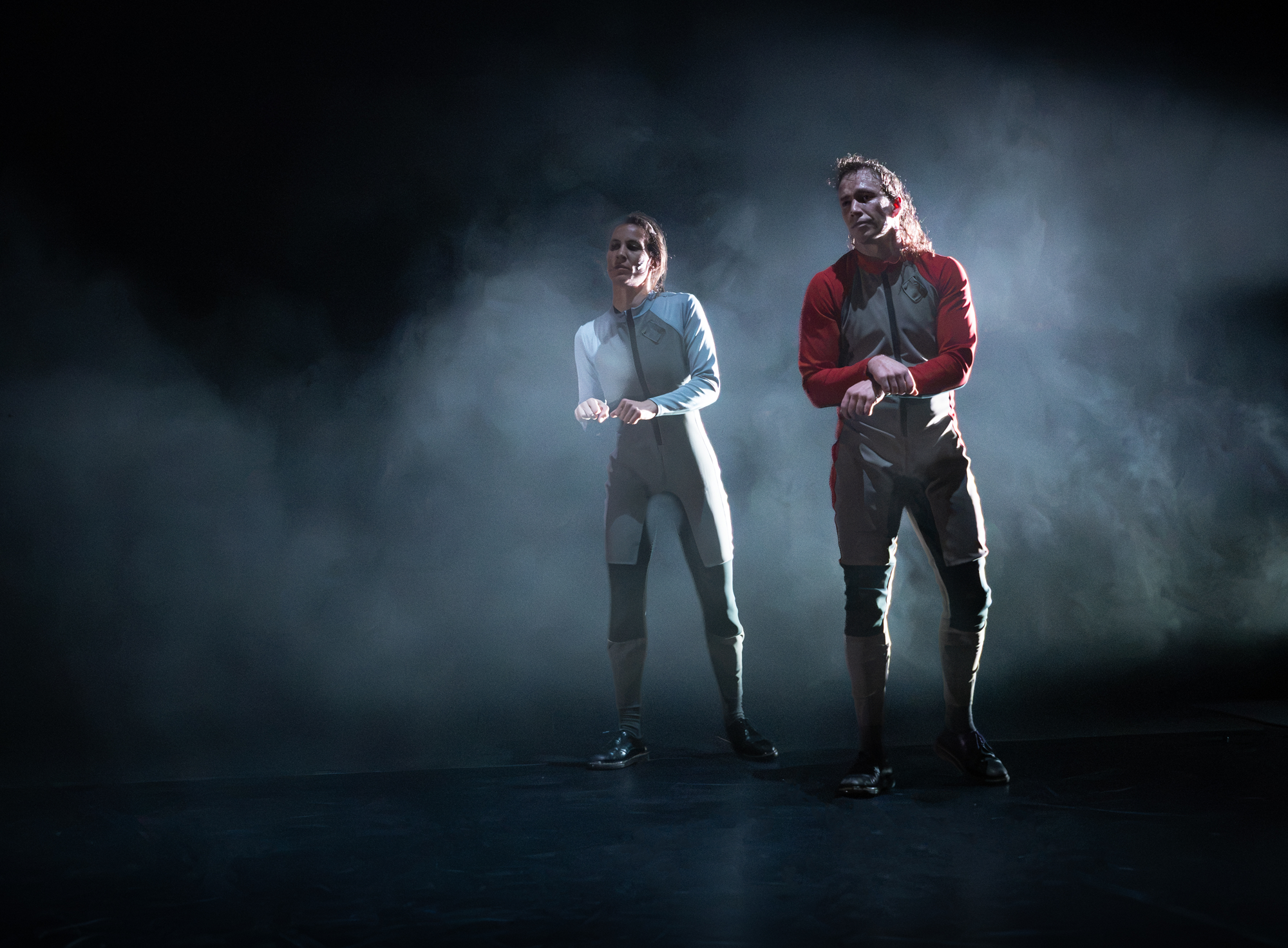
Leaping from the unconscious, it is not just horses cantering in the rain, but the Toreador Song[iv] from Bizet’s Carmen. Ritchie-Jones and Tancheff disappear from view and both return in the role of the bullfighter Escamillo, singing and gesturing to their fellow toreadors. “Giddy-up” comes the direction, thanks to sound design by Moses Carr and Nick Roder. “Remember not to smile with your teeth”, timely advice. Little by little, in costumes by Andrew Treloar, they are losing their outer layers, in reflection of changing states. A white t-shirt, here, a pair of pants, there, though the costume change is never on view, merely the result. Until finally they are left in red and blue banded, full length, wetsuit-like outfits, perfect for frequent aerial acrobatics. Such is the knack of once knowing your process inside out, you can “start to explore abandoning it and seeking out how it breaks”[v]. As Ritchie-Jones pitches Tancheff forward, they toy with the sound the voice makes as the body moves. Repeatedly tapping various parts of her body, the vibration of the sustained utterance fills the space and becomes its own everyday aria.
Throughout R.A.I.N, to relinquish is balanced by to resist. The same also applies to humour countered by downheartedness and solemnity. After the rain, somewhere in the middle, “a horse rolls”[vi]. Falling softly, assuredly. But falling. Fade to black, the last mournful note.
[i] The RAIN acronym was originally coined by Michele McDonald, and further developed by Tara Brach. RAIN, https://www.tarabrach.com/rain-practice-radical-compassion, accessed 17th September, 2026.
[ii] Harrison Ritchie-Jones, R.A.I.N, Arts House, https://www.artshouse.com.au/events/r-a-i-n/, accessed 16th September, 2026.
[iii] R.A.I.N has been assisted by Studio 24, Chunky Move and City of Melbourne. Chunky Move, R.A.I.N, https://chunkymove.com/events/r-a-i-n/, accessed 17th September, 2026.
[iv] Popular name for Georges Bizet’s aria Votre toast, je peux vous le render from act II, Carmen (1875).
[v] Harrison Ritchie-Jones, R.A.I.N Artist Statement, Arts House, https://www.artshouse.com.au/events/r-a-i-n/, accessed 16th September, 2026.
[vi] English translation Bizet’s aria Votre toast, je peux vous le render.
Image credit: Harrison Ritchie-Jones and Michaela Tancheff in R.A.I.N choreographed by Ritchie-Jones, photographed by Darren Gill
